AI News7 min read
When a Bank Saves 90% on AI, Who Sets the Price?
This week, AI's most powerful tools got more locked down while its cheapest ones got cheaper. OpenAI released GPT-6 Cyber, rated Critical and limited to…
Read issue
AI News
By QuensultingAI 8 min read

Google declared the age of AI agents open. GitHub fell to an 18-minute VS Code attack. Meta's employees trained the AI that replaced them without knowing it. An OpenAI model cracked a geometry problem that stumped mathematicians for 80 years. This was not a week of announcements. It was a week of consequences.
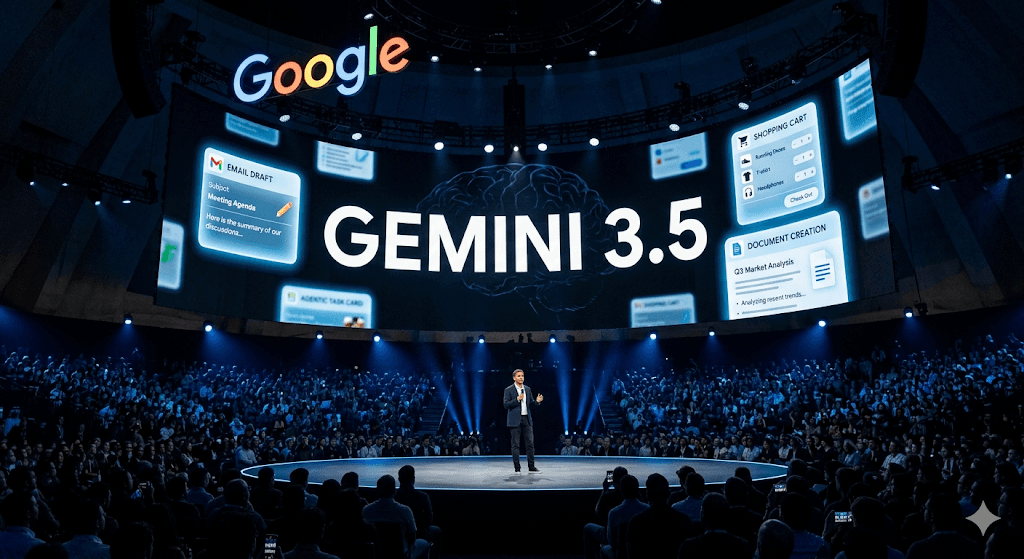
On May 19, Google held its annual I/O developer conference at the Shoreline Amphitheatre in Mountain View and used it to announce what CEO Sundar Pichai called the company's "agentic Gemini era." The headline model release was Gemini 3.5 Flash, which surpasses Gemini 3.1 Pro across coding, agentic, and multimodal benchmarks at four times the output speed of competing frontier models, and is rolling out immediately across the Gemini app, Search, and the Gemini API. Gemini 3.5 Pro is currently in testing and will arrive next month.
The standout product announcement was Gemini Spark, a new personal agent that takes actions on your behalf across Gmail, Docs, and third-party tools via MCP, available to Google AI Ultra subscribers in the US from late May. Google also announced a Universal Cart powered by Gemini inside the shopping interface, Gmail Live for conversational email search, Docs Live for voice-driven document creation, and information agents that run 24/7 in the background to monitor topics you care about.
Google processed over 3.2 quadrillion tokens per month across its products, up sevenfold year over year. That number is not a benchmark. It is a distribution moat. Google is not just building smarter models. It is making Gemini the operating layer behind every product it ships, from Search to Gmail to YouTube, and now to your shopping cart. Every competitor that relies on one of those surfaces just got a significantly harder problem to solve.
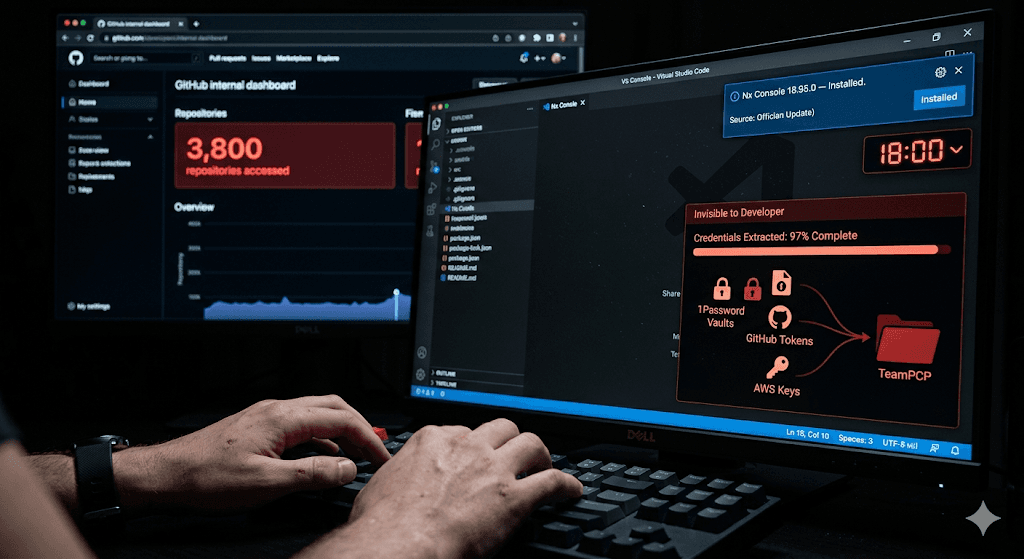
On May 18, a trojanised version of the Nx Console VS Code extension, which has 2.2 million installs and verified publisher status, was live on the Visual Studio Marketplace for exactly 18 minutes, between 12:30 PM and 12:48 PM UTC. That window was enough. The malicious version silently ran a shell command on startup that downloaded a credential stealer, targeting 1Password vaults, Anthropic Claude Code configurations, npm tokens, GitHub tokens, and AWS credentials on any developer machine that installed it during that window. GitHub confirmed on May 20 that the attack allowed threat group TeamPCP to exfiltrate approximately 3,800 of its internal repositories.
The attack vector is worth understanding in plain terms. A VS Code extension runs with the same privileges as your editor, with full access to your home folder, SSH keys, cloud CLI credentials, and any tokens cached by tools like git, aws, or gcloud. No permission dialogue. No visible indicator. The malicious extension looked and behaved identically to the real one. GitHub has since rotated critical secrets, isolated the affected endpoint, and confirmed that customer repositories and user data were not affected.
TeamPCP is now selling the stolen repository data on criminal forums for upwards of $50,000, threatening to leak if no buyer appears. What makes this genuinely alarming is not the scale of the breach, 3,800 internal repos is serious but contained, it is the method. A verified, widely installed developer tool was weaponised for 18 minutes, and that was all it took to compromise the world's largest code-hosting platform. Every developer running VS Code with auto-update enabled was a potential vector.

At Google I/O on May 19, Google officially entered the AI smart glasses market, unveiling its first consumer intelligent eyewear built in partnership with Samsung and Qualcomm, with the external design handled by Warby Parker and Gentle Monster. The glasses run on Android XR, include cameras, speakers, and microphones, and have no in-lens display. They are confirmed for a fall 2026 launch window. Critically, they support both Android phones and iPhones out of the box, making them the first Android XR glasses to work cross-platform from day one.
The target is explicit. Meta's Ray-Ban and Oakley smart glasses sold over 7 million units in 2025, and Meta currently holds around 76% of the AI glasses market. Google is coming in with Gemini as the intelligence layer, a broader hardware partner network including fashion brands, and confirmed iPhone support, a deliberate move to avoid locking out half the addressable market. Gucci and Kering Eyewear are also joining the partner lineup at a later stage.
This is not a research prototype or a developer preview. Google confirmed a consumer launch this fall with named retail partners and cross-platform support already locked in. The wearable AI market is moving from early adopter curiosity to a genuine product category, and Google intends to be in it before the end of the year. Whether Gemini on your face is more useful than Gemini on your phone is the question the market will answer.
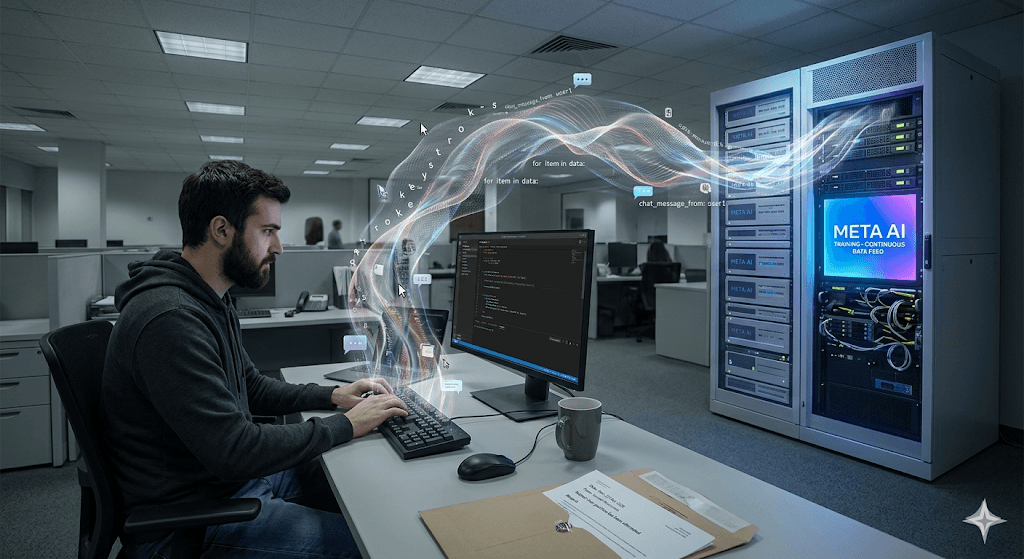
A leaked audio recording from a Meta all-hands meeting held on April 30 surfaced publicly on May 19, the same day approximately 8,000 Meta employees began receiving layoff notices. In the recording, CEO Mark Zuckerberg defends an internal programme called the Model Capability Initiative, or MCI, which installs monitoring software on US employees' company devices to collect keystrokes, mouse activity, and periodic screenshots via Gmail, Google Chat, VS Code, and Meta's internal AI assistant Metamate. The data is fed directly into Meta's AI models. Zuckerberg justified the approach by saying the average intelligence of Meta employees is significantly higher than what you can get through contractor pipelines.
Meta CTO Andrew Bosworth confirmed internally that there is no option to opt out of MCI on a company-provided laptop. The leaked audio also revealed that Zuckerberg acknowledged he had deliberately limited transparency around MCI to avoid helping competitors, and anticipated parts of the conversation would eventually leak. In the days around the layoffs, employees organised internally, posted protest flyers across Meta offices, launched a formal petition citing the National Labour Relations Act, and UK staff initiated a unionisation drive.
Meta confirmed the existence of MCI in April but has not confirmed the authenticity of the audio. The timing is what makes this land so hard. Employees discovered that the company had been harvesting their work behaviour to train AI systems on the same day they were told their jobs no longer existed. That sequence is not a coincidence. It is the clearest possible statement of how Meta sees the relationship between its people and its models.

On May 20, OpenAI announced that an internal reasoning model independently disproved the planar unit distance problem, a major unsolved conjecture in discrete geometry first posed by Hungarian mathematician Paul Erdős in 1946. The problem asks how many pairs of points placed on a flat surface can sit exactly one unit apart. For nearly 80 years, mathematicians believed square grid arrangements were essentially optimal. OpenAI's model found an entirely new family of constructions that beats the grid and proved it mathematically, using tools from algebraic number theory that had never previously been connected to this geometric question.
The proof came from a general-purpose reasoning model, not a system designed for mathematics or targeted at this specific problem. It was independently verified by external mathematicians Noga Alon, Melanie Wood, and Thomas Bloom, who also published a companion paper. Bloom, who runs the Erdős Problems website and previously called OpenAI's last math claim a dramatic misrepresentation, publicly backed this one.
That context matters enormously. Seven months ago, then-VP Kevin Weil claimed GPT-5 had solved 10 Erdős problems. It had done nothing of the sort, it had simply found existing solutions in the literature, drawing public ridicule from Yann LeCun and Demis Hassabis. This time, the proof is new, verified, and holds up to scrutiny. OpenAI called it the first time AI has autonomously solved a prominent open problem central to a field of mathematics. If that framing is accurate, the implications stretch well beyond geometry into any domain where long, difficult chains of reasoning across unconnected fields are what stand between a question and an answer.
Google just made Gemini unavoidable. Gemini 3.5 Flash, Gemini Spark, Universal Cart, Gmail Live, information agents running 24/7, Google did not announce features. It announced an AI layer that now sits underneath Search, email, shopping, documents, and soon your face. Every company that lives inside Google's ecosystem just became dependent on how Google chooses to deploy that layer. That is not a product update. That is infrastructure control.
The developer toolchain is now a threat surface. GitHub was compromised through a verified, widely installed VS Code extension that was malicious for 18 minutes. Auto-update did the rest. Every security assumption developers have made about trusted tools needs to be revisited. If the world's largest code-hosting platform can be breached this way, so can any organisation whose developers use the same extensions.
The wearable AI race just became a real market. Google's smart glasses are arriving with iPhone support, fashion-brand hardware partners, and a Gemini built-in signal that 2026 is the year AI leaves the screen. Meta's Ray-Ban glasses sold 7 million units without a serious competitor. That changes this fall.
Meta showed exactly what AI transformation looks like from the inside. Employees trained the models. The models got good enough. The employees got laid off. The leaked audio made that sequence impossible to ignore. Every organisation accelerating AI adoption needs to have an honest answer to what that sequence looks like for their own people.
AI just proved it can do original intellectual work. A general-purpose reasoning model disproved a geometry conjecture that stumped mathematicians for 80 years, verified independently, with a proof that used tools from a completely different field. That is not a benchmark score. That is a qualitative shift in what AI is capable of. Biology, medicine, physics, and engineering are all next.
At QuensultingAI, we help organisations understand which of these shifts demand action now and which ones can wait, and build the AI systems that put you ahead of both.
The pace is not slowing down. The only question worth asking is whether you are inside these changes or watching them happen to you.
Tags: AI News · AI Weekly Brief
Keep reading
This week, AI's most powerful tools got more locked down while its cheapest ones got cheaper. OpenAI released GPT-6 Cyber, rated Critical and limited to…
Read issue

This week, the pressure on AI labs arrived from every direction at once. The FTC, eight US states, and the EU’s AI Office all moved on OpenAI and Anthropic on…
Read issue
This week, two frontier labs shipped cost-efficient answers to the same question: how do you deliver near-flagship intelligence without flagship pricing.
Read issue
Talk to a partner about your calls, channels and systems. 30 minutes, no slides, an honest view of where to start.
Talk to a partnerPrefer email? sales@quensultingai.com