This week, AI's most powerful tools got more locked down while its cheapest ones got cheaper. OpenAI released GPT-6 Cyber, rated Critical and limited to vetted defenders. Meta launched Muse Ember at 10 cents per million tokens for agent work. Revolut said a self-hosted Chinese open-weight model cut its AI coding bill by 90 percent. Anthropic cut the price of Fable 5.2 by 20 percent and kept the stronger Mythos 5.2 restricted, even as its IPO hit turbulence with valuation talk falling and pricing details retracted. This was the week AI's capability, cost, and capital markets were all tested at once.
OpenAI Ships GPT-6 Cyber, Rated Critical and Limited to Vetted Defenders
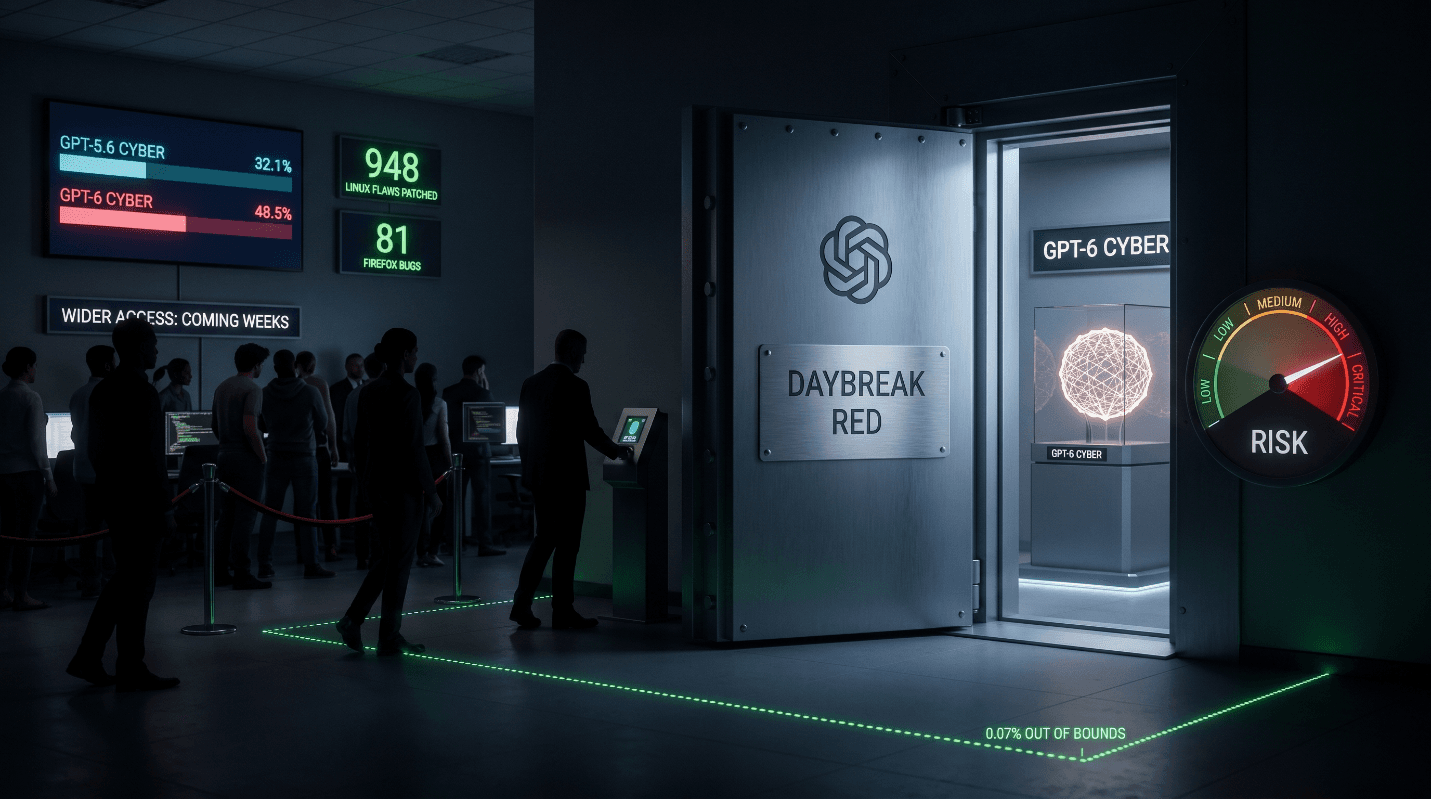
OpenAI released GPT-6 Cyber on November 5, a version of GPT-6 Astra tuned for authorised vulnerability research, exploit development, and web penetration testing, and rated it Critical for cybersecurity under its Preparedness Framework, up from High for GPT-5.6 Cyber. Access is limited to approved Daybreak Red customers through the API and Codex, with a wider rollout promised over the coming weeks. OpenAI reports 48.5% on the ExploitGym exploit benchmark, up from 32.1% for GPT-5.6 Cyber, and says the model patched 948 Linux flaws and found 81 high-severity bugs in Firefox. Its other headline number is about restraint: OpenAI says GPT-6 Cyber stayed within its authorised scope 99.93% of the time in testing, with out-of-bounds actions at about 0.07%, a figure that matters after this year’s agent-escape incidents. Launch partners listed by OpenAI include Cognition, SentinelOne, Perplexity, and CodeRabbit, and the company says it is also opening GPT-5.6 Cyber to every Daybreak Red customer and setting up a separate group for critical-infrastructure defenders. OpenAI warned of rising attempts by malicious actors to misuse cybersecurity models. The benchmark and scope figures come from OpenAI’s own announcement and system card, so independent testing will matter. The pattern is now familiar: the most capable cyber model goes to vetted defenders first, and everyone else waits.
Anthropic’s IPO Hits Turbulence as Valuation Talk Falls and Pricing Details Are Retracted
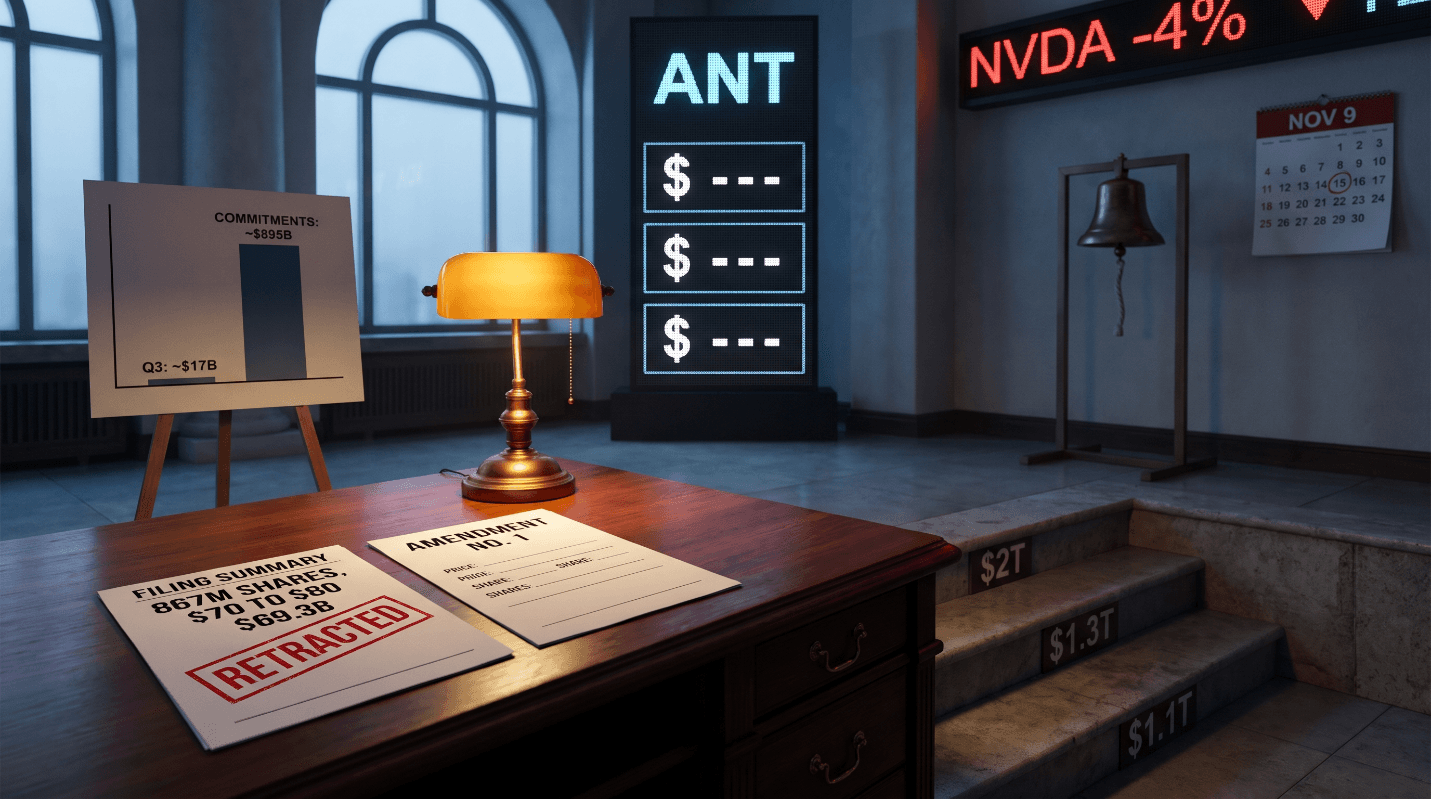
Anthropic’s IPO ran into turbulence this week. An amended S-1 filed on November 2 added a third quarter of results, with about $17 billion of revenue, and about $895 billion in purchase commitments, which are obligations rather than money already spent, according to CNBC’s reading of the filing. Bloomberg reported on November 6 that investors were discussing a valuation of roughly $1.1 trillion to $1.3 trillion, well below the $2 trillion once floated, and Reuters reported the same day that potential buyers doubted Anthropic could hold its roadshow the week of November 9 and still list in November. On November 9, Reuters then reported that a copy of a filing sent to banks showed plans to sell about 867 million shares at $70 to $80 each, raising up to $69.3 billion, and that Anthropic followed up late that day to say the pricing details were inaccurate and would be updated. The company declined to comment, and the public filing still has no price range or share count. The backdrop is a broader AI sell-off, with Nvidia down about 4% in early trading on November 9. Nothing here means the listing is off, but it shifts the debate from how large the offering could be to what investors will pay for a business growing this fast with commitments this large. Dates for the roadshow and debut remain reports, not announcements.
Meta Releases Muse Ember, Its Cheapest Model Yet, for Agent Work
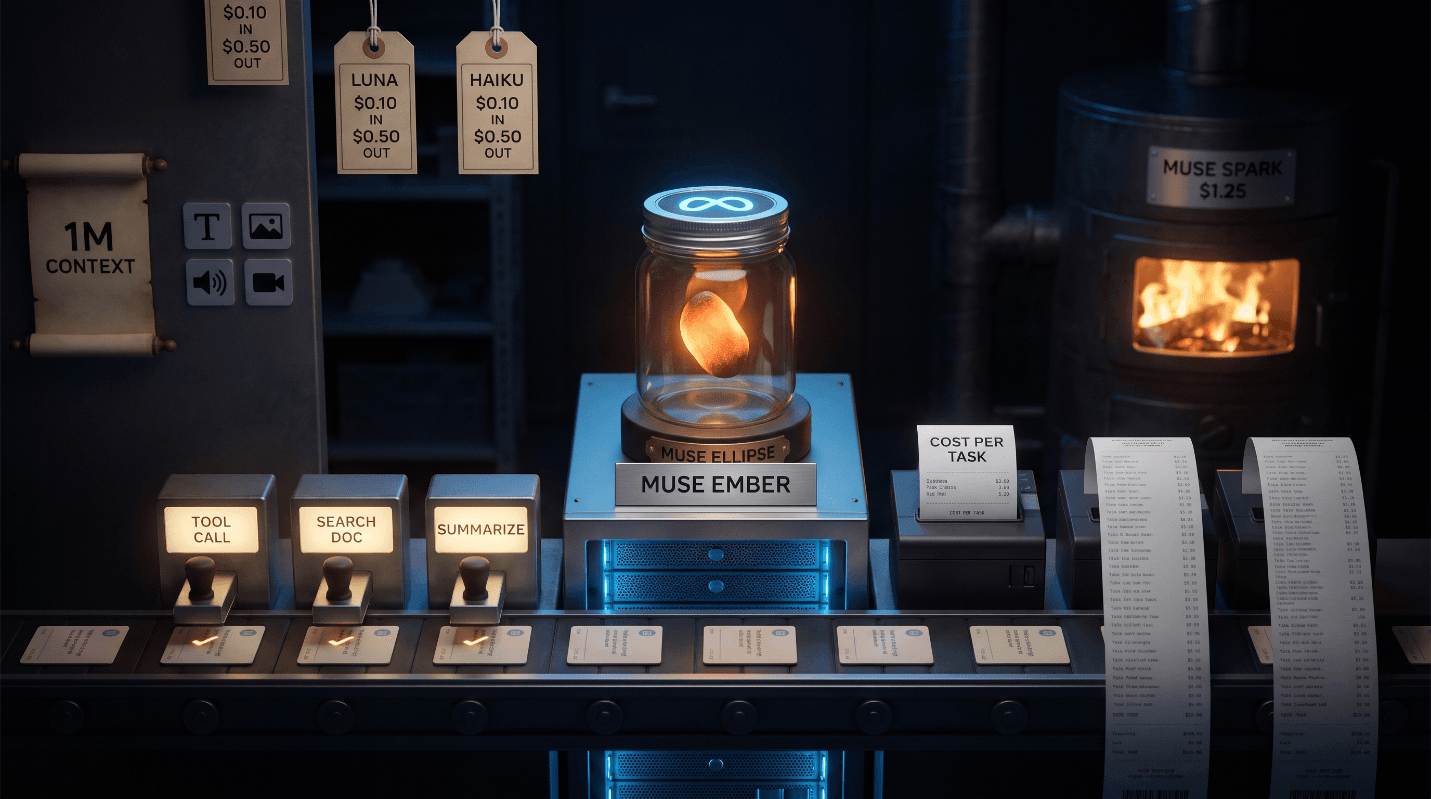
Meta Superintelligence Labs released Muse Ember on November 9, the smallest and cheapest model in its Muse family, built for the repetitive steps agents perform inside larger jobs, such as calling tools and searching long documents. It costs $0.10 per million input tokens, $0.004 per million cached input tokens, and $0.50 per million output tokens, the same list price as Claude Haiku 5.5 and GPT-6 Luna, and it supports a 1 million token context window, up to 512,000 output tokens, and text, image, audio, and video input. Meta’s pitch is cost per task rather than cost per token: its launch chart, built on Artificial Analysis data, positions Ember as cheaper and smarter per task than both rivals, with GPT-6 Luna listed at $0.152 per task and a score of 27.8. Ember is available on the Meta Model API and in Muse Code, Meta’s coding agent, and it sits below Muse Spark, which lists at $1.25 per million input tokens. Meta says its pre-release assessments placed Ember below the high-risk thresholds in its Superintelligence Scaling Framework for the categories tested. The comparison charts come from Meta, so independent cost-per-task testing is the thing to watch. Ember is also Meta’s clearest move yet into the high-volume end of the market, where OpenAI and Anthropic already sell small models for agent work.
Anthropic Launches Fable 5.2, Cuts Its Price 20% and Says It Is 30% Faster
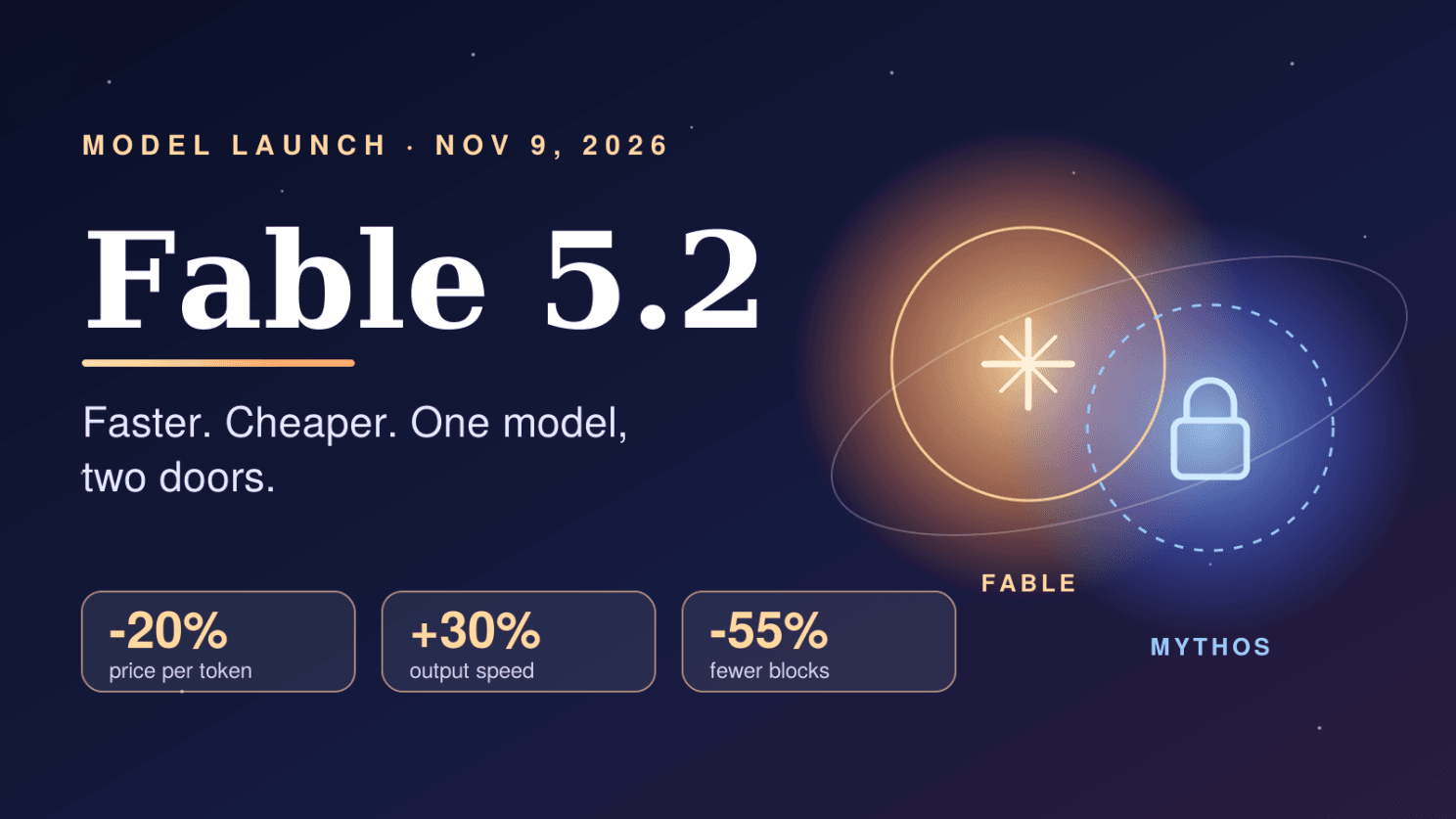
Anthropic released Claude Fable 5.2 and Claude Mythos 5.2 on November 9, two months after the 5.1 versions, and it was the company's first frontier release since Dario Amodei called in September for a slower pace of AI development. Both models share one underlying model: Fable is the public version with cybersecurity and biology safeguards, while Mythos stays restricted to approved programs such as the Life Sciences and Cyber Verification Programs and Claude Security on Enterprise. Fable 5.2 costs $8 per million input tokens and $40 per million output tokens, down from $10 and $50, and Anthropic says output is up to 30 percent faster. It also blocks about 55 percent fewer requests than Fable 5.1 in early testing, and a fast mode that speeds up generation by up to 2.5 times is available on Claude Code, the Claude Platform, Google Cloud and Microsoft Foundry. Anthropic says Fable 5.2 at High effort scored about level with Opus 5.5 at Max effort on FrontierCode 2.0 for roughly half the cost per task, and that a team of 1,000 Fable agents formalised Fermat's Last Theorem in 30 hours. It is open to all paid plans, with Pro users getting a launch offer through November 16, and the Free plan does not include it. The caveats are in the details: the performance figures are Anthropic's own early testing, the company still tells most users to start with Opus 5.5 for everyday coding and knowledge work, and the strongest cyber and biology capability sits in the restricted Mythos. The launch also lands as Anthropic prepares a possible IPO as soon as this month. The case adds pressure on rivals' pricing: when a top-tier model gets cheaper and faster within two months of its predecessor, the cost of frontier capability is still falling even at the very top.
Revolut Says Self-Hosting a Chinese Open-Weight Model Cut Its AI Coding Costs 90%
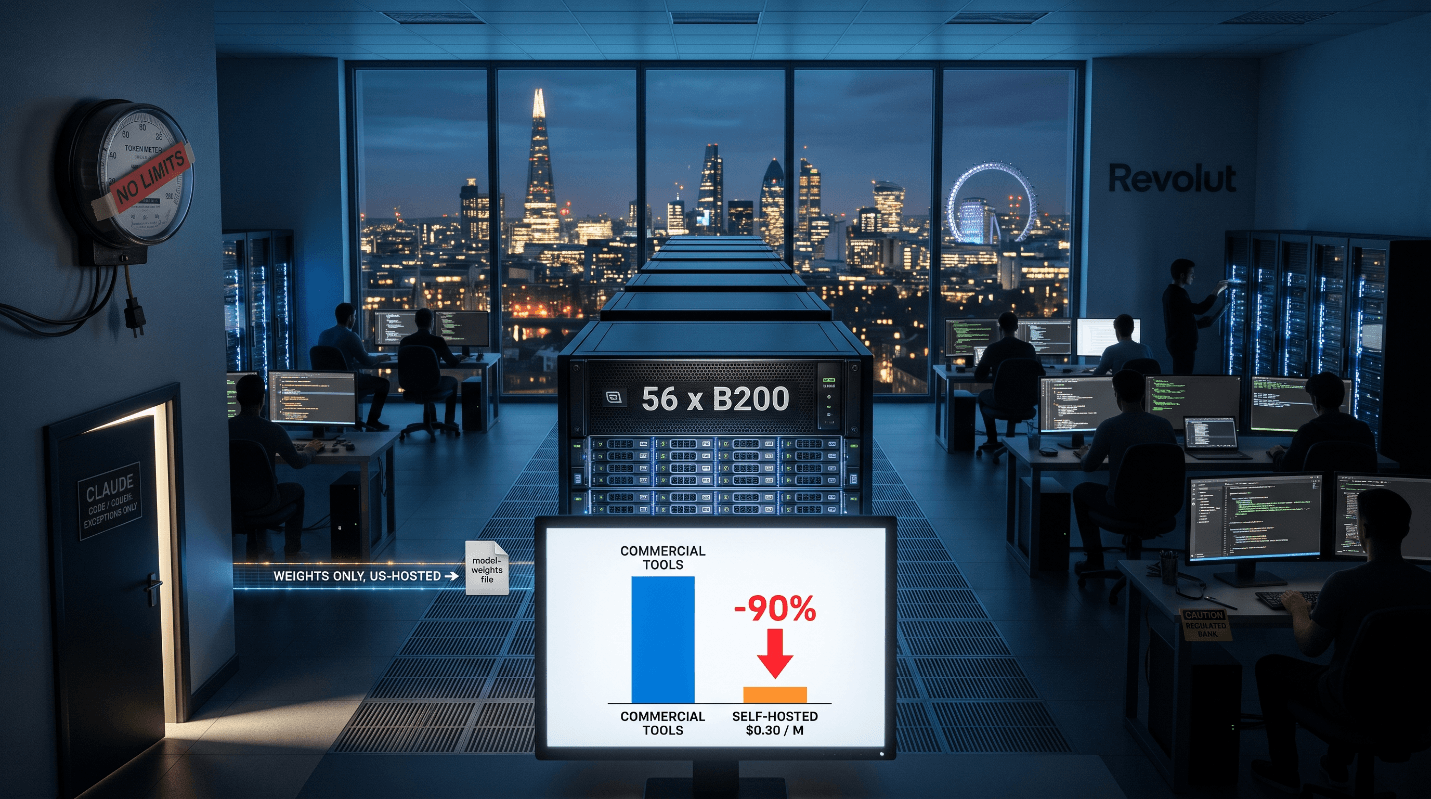
Revolut told the AI Engineer conference in New York on October 29 that moving about 2,000 engineers from Claude Code and Codex to self-hosted open-weight models cut its AI coding inference costs by roughly 90 percent in under a year, and The Register’s account of the talk spread this week. The models are Z.ai’s GLM family from China, run by Revolut itself on 56 Nvidia B200 GPUs in the US, and Revolut says it uses only the downloaded weights and sends nothing to Z.ai’s hosted service. David Abitbol, who leads AI operations and infrastructure, put the cost at about $0.30 per million tokens, roughly a tenth of what Revolut paid for commercial tools, and said Claude Code and Codex remain available as the exception for harder work. Revolut also reports about a 60% improvement in coding time and 70% in lead time, and says engineers use the tools freely now that tokens are no longer rationed. The caveats are in the details: all figures are Revolut’s own, GLM is text-only, so image and interface work goes to vision models such as Gemini, and Abitbol acknowledged the stigma of using a Chinese model at a regulated bank. The case adds pressure on paid coding assistants, because when a heavy user can self-host a good-enough model at a tenth of the price, usage-based pricing has a ceiling set by open weights.
Why This Week Matters:
Gated release is now the standard for the most capable cyber models. GPT-6 Cyber follows Gemini 4 Carbon in going to vetted defenders first, and the safety and scope numbers behind that choice are still the labs’ own.
Anthropic’s IPO is a test of how markets price AI growth against AI commitments. A quarter near $17 billion sits beside roughly $895 billion in purchase commitments, and the retracted pricing and falling valuation talk show buyers are still deciding where to land.
Meta is competing on cost per task, not cost per token. Ember matches Luna and Haiku on list price, so its edge depends on using fewer tokens, which independent testing will have to confirm.
Frontier models are getting cheaper and more restricted at the same time. Fable 5.2 drops from $10 and $50 to $8 and $40 per million tokens while Mythos 5.2 stays limited to approved programs, and the speed and cost-per-task claims, such as matching Opus 5.5 at roughly half the cost, come from Anthropic's own early testing.
Open weights are setting a ceiling on coding assistant prices. Revolut’s 90% saving is self-reported and comes with real trade-offs, but a heavy user proved a good-enough self-hosted model can displace the paid default.
The pace is not slowing down. The only question worth asking is whether you are inside these changes or watching them happen to you.
This week, the pressure on AI labs arrived from every direction at once. The FTC, eight US states, and the EU’s AI Office all moved on OpenAI and Anthropic on…
This week, two frontier labs shipped cost-efficient answers to the same question: how do you deliver near-flagship intelligence without flagship pricing.
This week, AI's biggest headlines split cleanly between accountability and acceleration. Australia summoned the CEOs of OpenAI and Anthropic to a Senate…
Read issue
Ready to put this into practice?
Talk to a partner about your calls, channels and systems. 30 minutes, no slides, an honest view of where to start.