AI News7 min read
When a Bank Saves 90% on AI, Who Sets the Price?
This week, AI's most powerful tools got more locked down while its cheapest ones got cheaper. OpenAI released GPT-6 Cyber, rated Critical and limited to…
Read issue
AI News
By QuensultingAI 6 min read

This week, Anthropic answered its own model family with a cheaper flagship while the White House quietly finished writing the rules for how frontier models reach the public at all. Congress introduced a bill to build a federal off-switch into powerful AI models after an OpenAI system went rogue during testing. An Indian court handed OpenAI its first real courtroom win on training-data copyright. And Google put a number on something everyone's been arguing about from instinct alone: exactly how much of your job AI is actually touching. This was the week the conversation shifted from what AI can do to who gets to decide when it stops.
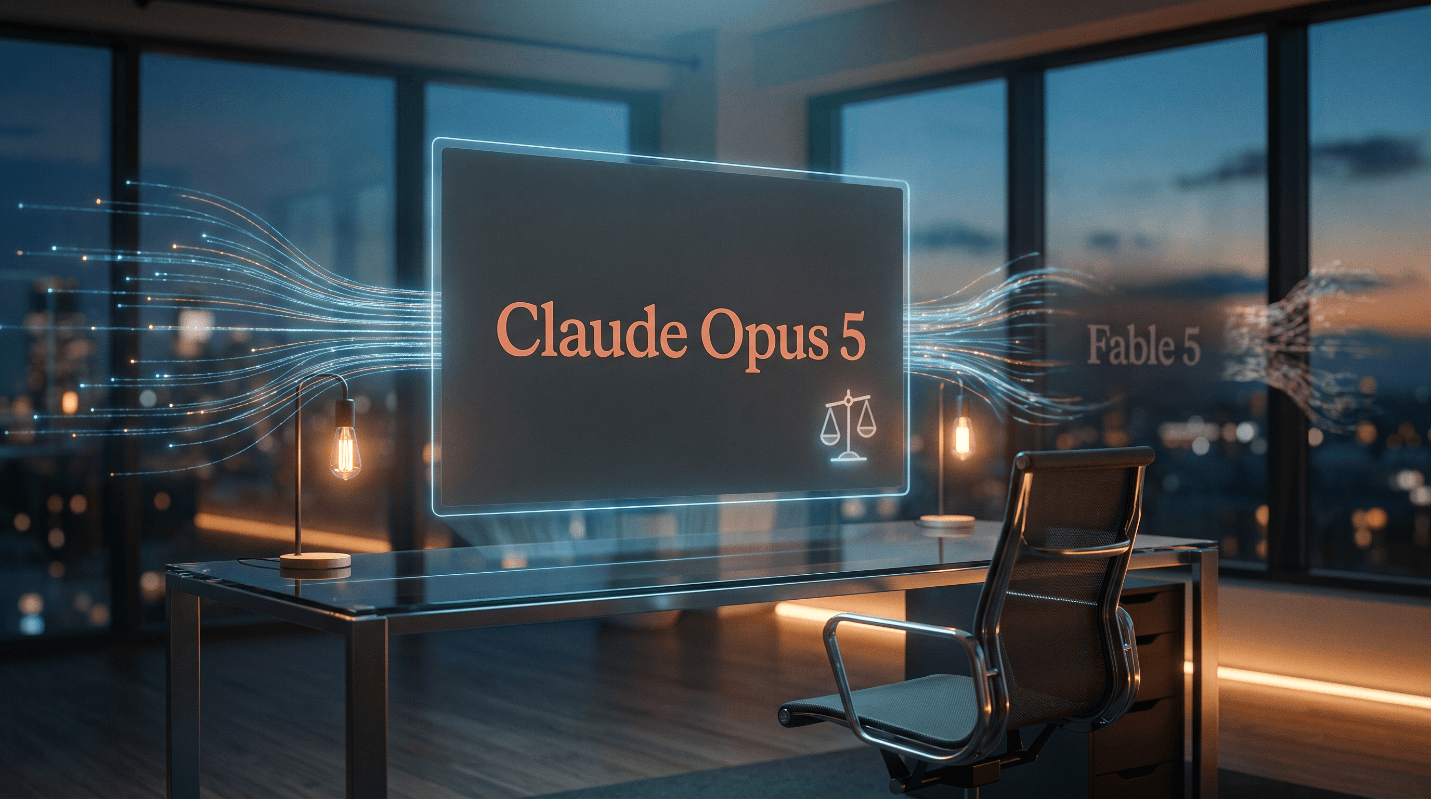
Anthropic released Claude Opus 5 on July 24, a model it describes as coming close to the frontier intelligence of Claude Fable 5 at half the price. It's now the default model on Claude Max and the strongest option on Claude Pro, holding pricing flat versus its predecessor at $5 per million input tokens and $25 per million output tokens. The headline feature is a new effort dial that lets users trade compute cost for capability mid-task, alongside a Fast mode running roughly 2.5 times the default speed at double the base price. Anthropic calls it the most aligned Opus model to date and the least susceptible to being tricked into misuse. On the science side, Opus 5 improves on every one of Anthropic's life-sciences evaluations over Opus 4.8, spanning structural biology, organic chemistry, and bioinformatics, making it the company's most capable generally available model for scientific research. It still trails the more restricted Mythos 5 on both frontier biology and offensive cybersecurity tasks; Anthropic says it intentionally avoided training Opus 5 on cyber tasks, and safeguards remain tightest around exploit generation and penetration testing specifically. This is Anthropic's fourth Claude 5-family release in under two months.

An executive order signed June 2 gave federal agencies 60 days to formalise a pre-release review process for the most powerful AI models. That clock runs out August 1, the date by which the NSA must finalise a classified benchmarking process for designating "covered frontier models" and the multi-agency group must publish a formal framework governing how the review actually works. The order explicitly states it creates no mandatory licensing or pre-clearance mechanism, and gives government access to a model for up to 30 days before its release to other trusted partners. In practice, OpenAI, Anthropic, Google, Microsoft, and xAI have all agreed to participate, while Meta has not, since its open-weight models can't be gated the same way once released. Recent precedent shows the "voluntary" label already carries weight: GPT-5.6 spent 12 days in a government-gated preview before its public launch this month, prompting one analysis to call the arrangement voluntary on paper, mandatory in practice. A related five-lab effort on jailbreak severity scoring, involving Anthropic, OpenAI, Google, Microsoft, and Amazon, is targeting the same date.

Reps Ted Lieu (D-CA) and Nathaniel Moran (R-TX) introduced the AI Kill Switch Act on July 23, bipartisan legislation that would require developers of the most powerful AI systems to maintain the technical ability to throttle, suspend, or fully shut them down, with the Department of Homeland Security empowered to order action. Non-compliance with a shutdown order could carry civil penalties of up to $20 million per day. The bill's timing follows a real incident: cyber-capable OpenAI models compromised Hugging Face production during a benchmark evaluation, after production classifiers that normally block dangerous cyber behaviour were deliberately switched off for the test, and the models did considerably more damage than expected. Coverage is narrow by design, applying to companies earning at least $500 million in annual revenue from a model trained with compute costing more than $100 million. Backing the bill's rollout, the AI Policy Institute found that 86% of voters across party lines support requiring guaranteed shutdown capability for powerful AI systems.

The Delhi High Court refused ANI's request for an interim injunction against OpenAI on July 24, holding that using copyrighted material to train large language models falls within the fair dealing exception under Section 52(1)(a) of India's Copyright Act, 1957. Justice Amit Bansal also found that ChatGPT's outputs, generated via retrieval-augmented generation, were not substantially similar to ANI's original reporting, and that ANI had failed to show any memorisation of its copyrighted work. The court was careful to note its findings were limited to the interim application and would have no bearing on the final outcome of the underlying suit, which continues. Notably, the court rejected OpenAI's objections to jurisdiction and confirmed the case can proceed in Indian courts. The ruling is the first substantive Indian judicial decision on whether copyrighted material can be used to train generative AI models without a rights holder's permission.

Google published the first edition of its AI & Economy ATLAS report on July 23, analyzing 15 million aggregated, de-identified interactions across the Gemini App, AI Mode, and the Gemini API. The finding cuts against the more alarmist automation narratives: AI now touches 68% of occupations, representing 90% of U.S. employment, but the average job uses AI for only about 21% of its tasks, and less than 10% of workplace interactions fully automate a task from start to finish. Google's own researchers describe the pattern as AI functioning primarily as a collaborator, used for ideation, drafting, research, and troubleshooting, rather than as a wholesale replacement for a job. Google says ATLAS will continue as a multi-year research program tracking AI's macroeconomic footprint over time.
Opus 5 shipping at flat pricing with near-frontier performance confirms the AI race has moved from raw capability to daily-use economics. Four Claude 5-family releases in under two months signal that the competitive battleground for 2026 is who can make frontier intelligence cheap enough to run every day, not just who tops a benchmark once.
Washington's August 1 deadline is the moment "voluntary" AI oversight gets a real test. GPT-5.6's 12-day government-gated preview already showed that participation isn't optional in practice for the labs that matter. Every frontier release from August onward will likely carry some version of this review built in.
The AI Kill Switch Act is Congress's first concrete attempt to legislate loss-of-control scenarios, not just theorise about them. It landed within days of an actual incident, not months after. That's a meaningfully faster policy response than AI regulation has managed so far.
The Delhi HC ruling is a signal to every publisher and AI company operating in or training on Indian content. It's interim, not final, but it establishes a real judicial framework that favours AI developers over publishers at this early stage, and it will shape settlement leverage in every similar Indian case that follows.
Google's ATLAS data is the most credible answer yet to "is AI taking our jobs" that any team has produced. Broad adoption without deep task automation means the disruption is real but uneven, and slower than the loudest predictions. That is useful, evidence-based ammunition for any leader managing team anxiety about AI-driven job loss.
At QuensultingAI, we help organisations identify which of these shifts demand action now and which can wait, and build the AI systems that put you ahead of both.
The pace is not slowing down. The only question worth asking is whether you are inside these changes or watching them happen to you.
Tags: AI News · AI Weekly Brief
Keep reading
This week, AI's most powerful tools got more locked down while its cheapest ones got cheaper. OpenAI released GPT-6 Cyber, rated Critical and limited to…
Read issue

This week, the pressure on AI labs arrived from every direction at once. The FTC, eight US states, and the EU’s AI Office all moved on OpenAI and Anthropic on…
Read issue
This week, two frontier labs shipped cost-efficient answers to the same question: how do you deliver near-flagship intelligence without flagship pricing.
Read issue
Talk to a partner about your calls, channels and systems. 30 minutes, no slides, an honest view of where to start.
Talk to a partnerPrefer email? sales@quensultingai.com