AI News7 min read
When a Bank Saves 90% on AI, Who Sets the Price?
This week, AI's most powerful tools got more locked down while its cheapest ones got cheaper. OpenAI released GPT-6 Cyber, rated Critical and limited to…
Read issue

AI did not wait for permission this week. It walked into Wall Street boardrooms, rewrote the iPhone, signed deals with its biggest critics, and forced the government to consider regulating it like a drug. The compute arms race accelerated. The consulting industry got its first serious challenger. And Apple quietly abandoned the idea that it needs to win the model race at all. Here is what you need to know.
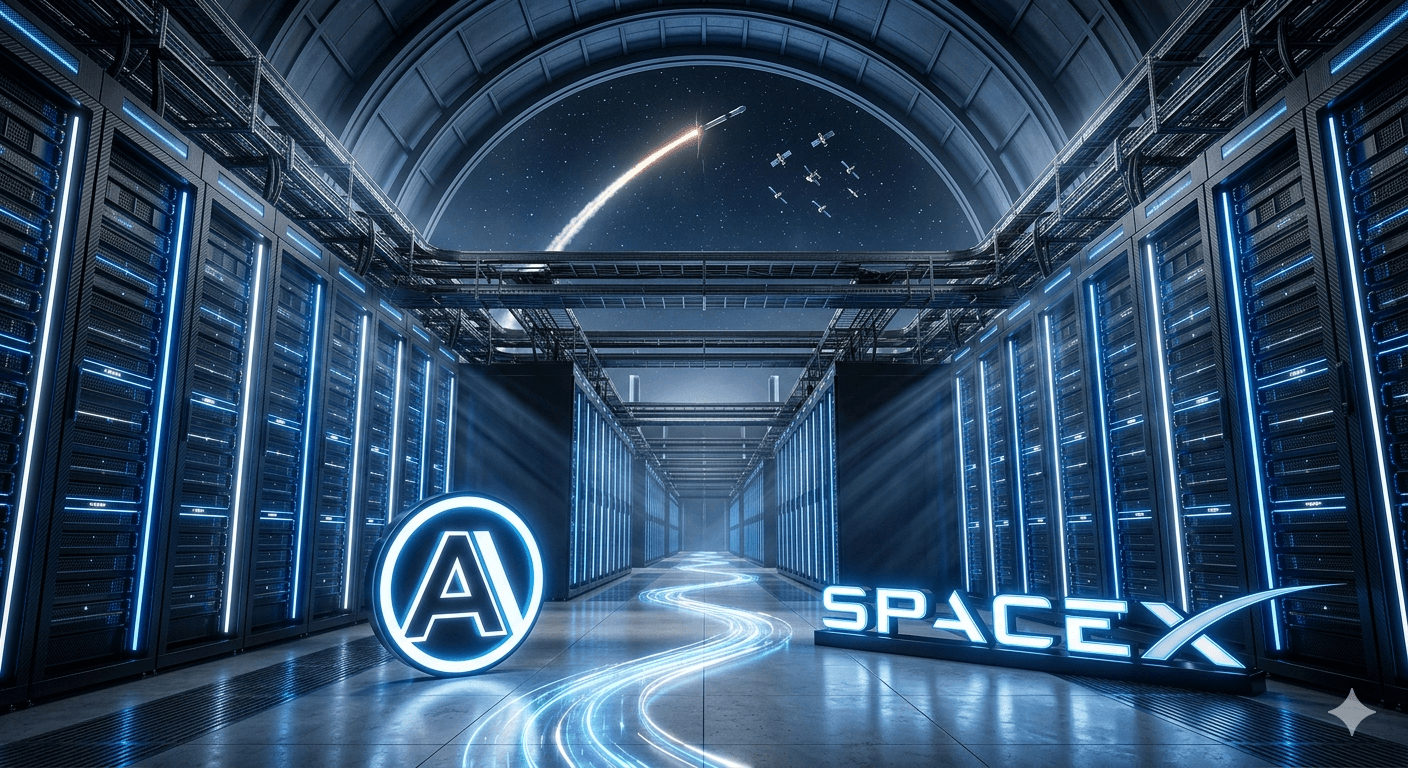
On May 6, Anthropic signed an agreement with Elon Musk's SpaceX to use the entire compute capacity of the Colossus 1 data centre in Memphis, Tennessee, one of the largest AI supercomputers ever built. The deal gives Anthropic access to over 300 megawatts of capacity across more than 220,000 Nvidia GPUs, including H100, H200, and next-generation GB200 accelerators, all coming online within the month.
The immediate effect is a meaningful lift for Claude Pro and Claude Max subscribers, rate limits are being raised, peak-hour reductions removed for Claude Code, and Opus API limits increased. This is Anthropic's latest in a string of major compute deals. The company already has a 5 gigawatt agreement with Amazon, a 5 gigawatt deal with Google and Broadcom, a $30 billion Azure capacity partnership with Microsoft and Nvidia, and a $50 billion US infrastructure investment with Fluidstack.
What makes this one unusual is the relationship it implies. Musk spent months calling Anthropic "woke", "misanthropic", and "evil" on X. He said they "hate Western civilisation." And then this week, after spending time with Anthropic's senior team, he wrote that he was "impressed" and that "no one set off my evil detector." The deal is good for both sides. Anthropic gets compute at a moment when demand for Claude Code is surging. SpaceX gets a marquee customer heading into what is expected to be the largest IPO in corporate history this June, targeting a valuation of $1.75 to $2 trillion. As part of the agreement, both companies also expressed interest in developing multiple gigawatts of orbital AI compute capacity in space, a signal that the next frontier of AI infrastructure may not be on the ground at all.

On May 6, Anthropic CEO Dario Amodei revealed at the company's Code with Claude developer conference in San Francisco that Anthropic posted 80 times year-over-year revenue and usage growth in Q1 2026. The number is not a typo. 80x. The growth reflects an explosion in enterprise adoption, led heavily by financial institutions. Amodei used the event to issue a stark warning to the broader SaaS industry: companies that fail to integrate AI into their core operations risk going bankrupt. He framed this not as speculation but as an emerging pattern already visible in the market. Complex software moats are narrowing as AI makes it easier to replicate functionality that once took years to build. The Mythos model, in particular, has already identified tens of thousands of vulnerabilities across industries during its controlled deployment. Amodei also called for clearer regulatory frameworks around powerful AI model releases, a notable position for a CEO whose company is simultaneously fighting the Trump administration in court over its Pentagon blacklisting. Anthropic's pre-IPO implied valuation, based on on-chain trading data, has hit $1.2 trillion, up 20% in seven days and 900% since October. The company that was labelled a "supply chain risk" by the Pentagon is now being valued like a sovereign-scale technology asset.

On May 4, Anthropic announced it has partnered with Blackstone, Hellman & Friedman, and Goldman Sachs to launch a new AI-native enterprise services company, one that puts the Claude maker in direct competition with the world's largest consulting firms for the lucrative business of corporate AI transformation. Anthropic, Blackstone, and Hellman & Friedman are each contributing roughly $300 million, with Goldman Sachs at $150 million. Apollo Global Management, General Atlantic, Leonard Green, GIC, and Sequoia Capital also participated. The new firm will not function as a traditional software vendor. It will embed Anthropic engineers directly inside mid-sized companies, community banks, regional hospitals, and manufacturers to redesign workflows and integrate Claude into core operations. The model mirrors Palantir's forward-deployment playbook, but with ownership of the underlying model built in. The announcement came just hours before Bloomberg reported that OpenAI was raising funds for a near-identical venture called The Development Company, targeting $4 billion from 19 investors against a $10 billion valuation. Both companies arriving at the same structure in the same week is not a coincidence. It signals that the next major battleground in AI revenue is not software licensing but implementation. For every dollar companies spend on software, they spend six on services. That ratio has made consulting a multi-trillion-dollar industry for decades. Anthropic and OpenAI are now both positioning to disrupt it not by replacing consultants with AI, but by becoming the AI-native consulting firms of the next era.

On May 5, Bloomberg's Mark Gurman reported that Apple will allow users to choose from a range of outside artificial intelligence services to power features across its software, building on a strategy to turn its devices into a comprehensive AI platform. The feature, internally referred to as "Extensions", will let iPhone users choose from multiple third-party models from companies like Google and Anthropic, including the ability to set custom voices in Siri depending on which external model is responding. The change is coming with iOS 27, iPadOS 27, and macOS 27 this fall, and will be revealed in detail at WWDC on June 8. This is a significant strategic pivot. Apple has spent years building a tightly controlled AI ecosystem, with everything processed on-device or within its own cloud framework. The Extensions system dismantles that philosophy in favour of an open platform model. Rather than competing head-on to build the most powerful models in-house, Apple is positioning itself as the layer through which every AI competes. The iPhone is already where users communicate, pay, photograph, search, and store personal context. If Apple can make that device the flexible hub through which Gemini, Claude, and ChatGPT all operate, it does not need to win the model race; it needs to own the surface on which that race is run. The timing is notable. This is the first major strategic AI announcement since Apple named John Ternus as incoming CEO, effective September 1. The market has been asking whether a hardware engineer can lead an AI-first Apple.
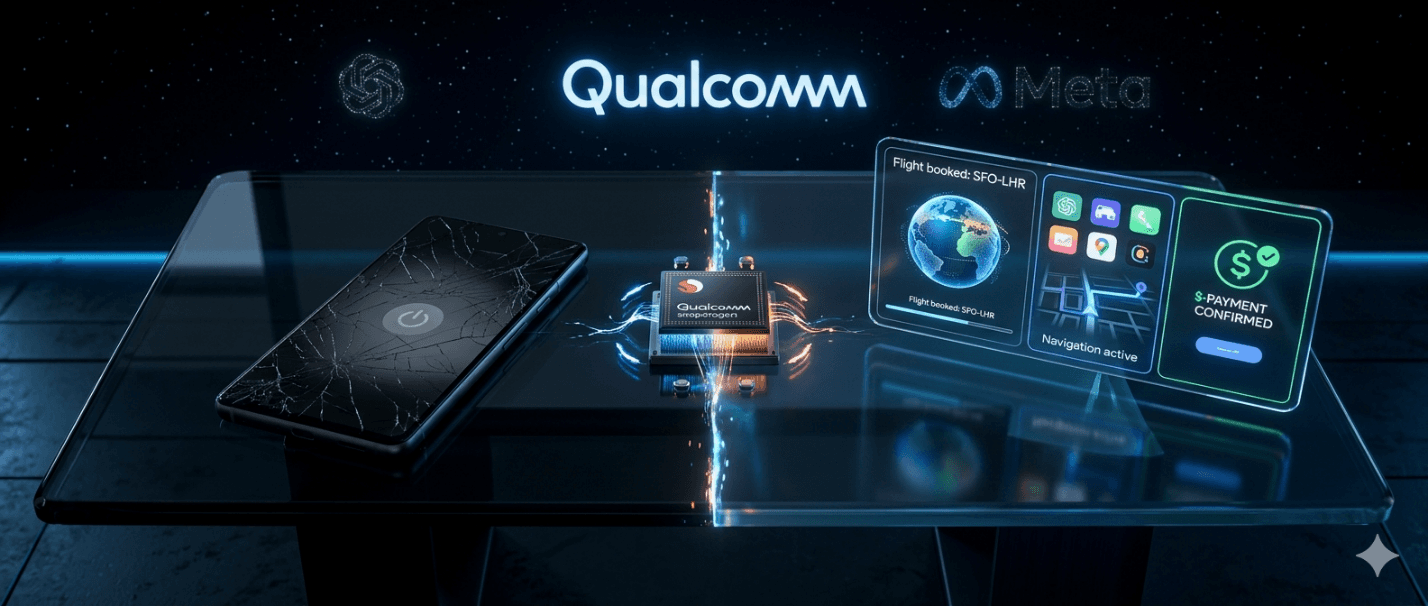
On May 9, Qualcomm CEO Cristiano Amon said publicly that 2026 is the year AI agents go mainstream and that the smartphone's reign as the primary personal device is ending. Speaking with Fortune, Amon said he is currently working with "pretty much all" major AI players on top-secret next-generation devices, declining to name companies or products. His argument is structural. For decades, Apple and Google dominated the technology industry because they controlled the operating system and the App Store, the layers through which users accessed everything else. Amon's view is that this control point is now shifting. "It's not about the OS and the App Store," he said. "It's going to be what are the agents you select." Whoever owns the AI agent layer owns the relationship with the user. The early evidence is already visible. ByteDance launched an AI agent-operated handset in December that sold out its initial run of 30,000 units, a phone where the AI agent navigates apps, books tickets, and makes payments autonomously, bypassing the app layer entirely. Tencent's CEO called the device "extremely unsafe and irresponsible." Meituan, WeChat, and Alibaba moved within days to restrict Doubao's access to their platforms. The incumbents of the app economy felt the threat immediately and responded to it. A second-generation device from ByteDance is planned for later this quarter. Qualcomm supplies the chips for a significant share of the Android ecosystem and is well-positioned regardless of which agent platform wins. But Amon's comments signal something larger than the device wars, the OS wars, and the app wars of the last 20 years may all be prologue to the agent wars that are just beginning.
The compute arms race just got personal. Anthropic signing with SpaceX, a company whose CEO spent months calling it evil, tells you everything about how desperate the demand for compute has become. When ideology gives way to infrastructure this fast, the scale of what is being built is almost impossible to overstate.
The era of AI without a referee may be ending. The White House drafting an FDA-style vetting regime for AI models is the most significant regulatory signal since Biden's executive order was revoked. If mandatory pre-release review becomes law, the entire competitive landscape shifts overnight, favouring incumbents, slowing smaller labs, and handing government officials authority over what AI the public can access.
Apple just chose a platform strategy over a model strategy. Opening iOS 27 to Google, Anthropic, and any AI provider that qualifies is not a concession. It is a calculated bet that the most valuable position in AI is not building the best model, it is owning the surface through which every model reaches a billion users. Every AI lab just became dependent on Apple's goodwill.
The next AI battleground is implementation, not software. Anthropic launching a $1.5 billion joint venture with Goldman Sachs and Blackstone hours before OpenAI announced a near-identical structure signals that licensing models are no longer enough. The real money is in sitting inside companies and redesigning how they actually work. Consulting as an industry has its first genuinely existential threat.
At QuensultingAI, we help organisations make sense of these shifts and put them to practical use, from intelligent agents and workflow automation to AI deployments that deliver real outcomes.
The pace is not slowing down. The real advantage now belongs to the organisations that know which changes to act on and which ones to watch.
Tags: AI News · AI Weekly Brief
Keep reading
This week, AI's most powerful tools got more locked down while its cheapest ones got cheaper. OpenAI released GPT-6 Cyber, rated Critical and limited to…
Read issue

This week, the pressure on AI labs arrived from every direction at once. The FTC, eight US states, and the EU’s AI Office all moved on OpenAI and Anthropic on…
Read issue
This week, two frontier labs shipped cost-efficient answers to the same question: how do you deliver near-flagship intelligence without flagship pricing.
Read issue
Talk to a partner about your calls, channels and systems. 30 minutes, no slides, an honest view of where to start.
Talk to a partnerPrefer email? sales@quensultingai.com