AI News7 min read
When a Bank Saves 90% on AI, Who Sets the Price?
This week, AI's most powerful tools got more locked down while its cheapest ones got cheaper. OpenAI released GPT-6 Cyber, rated Critical and limited to…
Read issue
AI News
By QuensultingAI 4 min read
If you looked at the headlines this week, you probably felt it: the world of AI isn’t just advancing, it’s accelerating, straight toward our collective future, with medicine, climate, and the business world at the epicentre. This was one of those rare weeks where the pace of breakthroughs, partnerships, and honest industry self-reflection truly set the tone for what’s next.

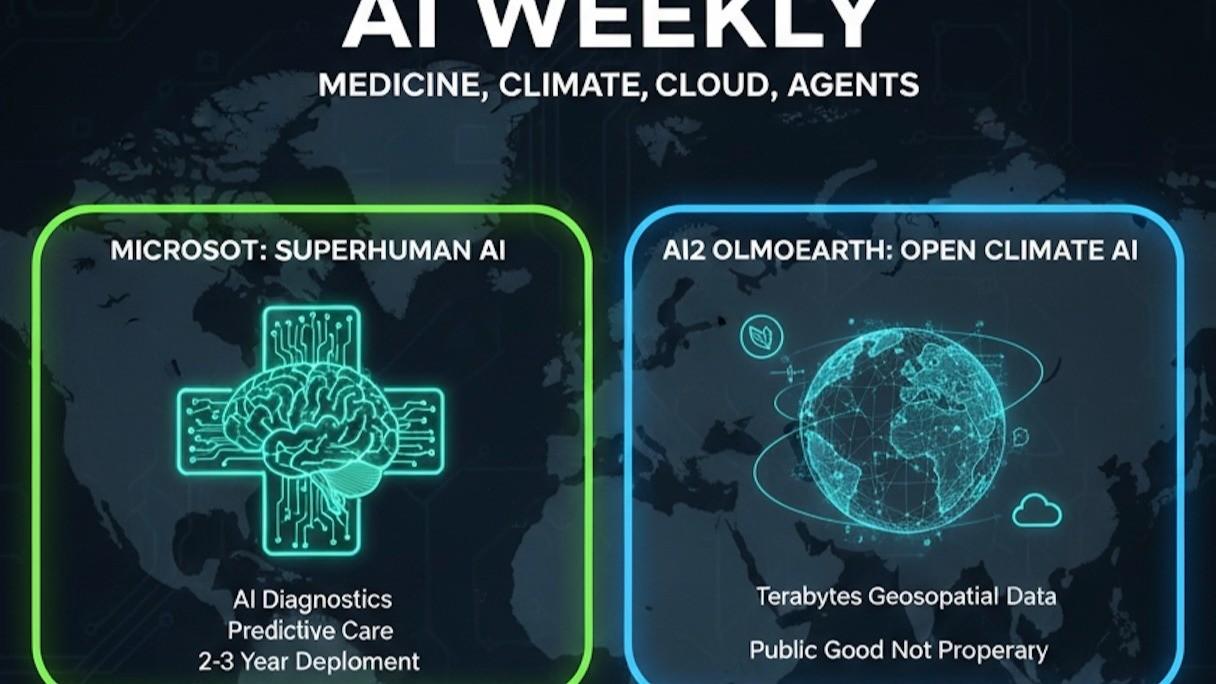
This week, Microsoft put a flag in new territory. The company announced the “MAI Superintelligence Team”, a group led by former Google DeepMind co-founder Mustafa Suleyman, aimed at building AI with “superhuman” abilities. But here’s what makes it different: they’re focusing first on medicine. Not just incremental improvements, but AI that, according to insiders, could exceed human doctors in diagnosing diseases, predicting patient risks, and potentially transforming preventative care.
Executives say the goal is rapid yet safe progress, targeting “humanist superintelligence” that works alongside people, not just for them. What’s striking is the time horizon: Microsoft isn’t talking about decades, but two or three years to reach and deploy systems that will make headlines in every hospital and research centre. The company positions medical diagnostics as the first domino, but the signals are clear, they’re thinking bigger, about every facet of human health and longevity.
There is an urgency to get this right, not just for the technological leap but because, as Microsoft puts it, “trust and safety will be foundational.” Bringing this vision to life will require a blend of world-class research, real-world validation, and, above all, a relentless focus on patient impact. The industry will be watching, closely and critically.

If you follow earth and climate tech, OlmoEarth is a name you’ll want to remember. The Allen Institute for AI (AI2) unveiled this open platform aimed at democratising environmental intelligence. Unlike older, academic data sets or siloed industry tools, OlmoEarth runs on cutting- edge multimodal AI models trained on terabytes of global satellite, drone, and sensor data.
What makes OlmoEarth a potential game-changer is accessibility. The platform doesn’t just monitor deforestation, crop health, or wildfire progression in near real time, it puts those insights in the hands of anyone, from government agencies to grassroots NGOs. AI2 isn’t shy about its ambitions, promising that its models outperform industry leaders for many geospatial intelligence tasks. And crucially, everything about OlmoEarth is built for transparency, customisation, and reproducibility, lowering the barriers that have kept planetary data out of reach for most.
With a rapidly changing climate and growing demand for data-driven environmental action, OlmoEarth’s vision is to turn AI-powered earth monitoring into a public good, not a proprietary advantage.

In AI infrastructure, the news was as large as the numbers: OpenAI will spread a jaw-dropping $600 billion across AWS, Oracle, and Microsoft Azure in the coming years, reshaping the very backbone of generative AI. Gone is the era of single-cloud loyalty, this new approach is multi-cloud, multinational, and massive.
The deal: roughly $250 billion to Azure for custom research clusters, $300 billion with Oracle for new global datacenters, and a headline-grabbing $38 billion committed to AWS in a single seven-year deal. For OpenAI, the move isn’t just about capacity; it’s about resilience and flexibility. And for the entire sector, it signals intense competition, forcing every provider to up their game in reliability, security, and innovation.
Expect this wave of investment to go far beyond powering next-gen models, it’s likely to spur spillover benefits for startups, academic researchers, and developers worldwide.

The numbers are in, and they tell a complicated but revealing story. According to McKinsey’s 2025 State of AI survey, around a third of organisations have successfully “scaled” AI, meaning they’re truly integrating AI systems beyond pilot projects into core business operations. That’s a modest increase, and the reasons are telling: talent shortages, difficulties integrating AI with legacy systems, and ROI anxiety continue to plague deployments.
Yet, there’s a new twist: autonomous and domain-specific “AI agents” are now gaining real ground, especially in customer service, supply chain, and analytics. The era of generalized chatbots is maturing into one of sophisticated agents handling negotiations, monitoring compliance, and optimizing processes on their own.
As AI agents step out of the lab, executives are talking less about “hype” and more about measurable business impact. The question is shifting from “can we?” to “how fast, and where to next?” The organisations that commit to deep talent investment and thoughtful scaling will define the next chapter of enterprise AI.
At QuensultingAI, we help translate these trends into business advantage, from AI-powered voice agents and chatbots to end-to-end automation pipelines. Let’s turn AI from a buzzword into a practical advantage for your organisation.
Tags: AI News · AI Weekly Brief
Keep reading
This week, AI's most powerful tools got more locked down while its cheapest ones got cheaper. OpenAI released GPT-6 Cyber, rated Critical and limited to…
Read issue

This week, the pressure on AI labs arrived from every direction at once. The FTC, eight US states, and the EU’s AI Office all moved on OpenAI and Anthropic on…
Read issue
This week, two frontier labs shipped cost-efficient answers to the same question: how do you deliver near-flagship intelligence without flagship pricing.
Read issue
Talk to a partner about your calls, channels and systems. 30 minutes, no slides, an honest view of where to start.
Talk to a partnerPrefer email? sales@quensultingai.com