This week was a model-launch week. OpenAI released GPT-6.2 Astra and Sol, cutting Astra's API price by 20%. Google shipped Gemini 4 Neon, its fourth Gemini 4 model since September. Microsoft launched seven in-house MAI models at Ignite, pitched at a fraction of rivals' prices. Thinking Machines released Inkling 2 Mini, an open model that runs on a 32GB Mac. And Anthropic went public in the largest IPO ever, then gave back much of its first-day pop as AI stocks slid. This was the week the model race became a race on price per task.
OpenAI Releases GPT-6.2 Astra and Sol, Cutting Its Flagship Price by 20%
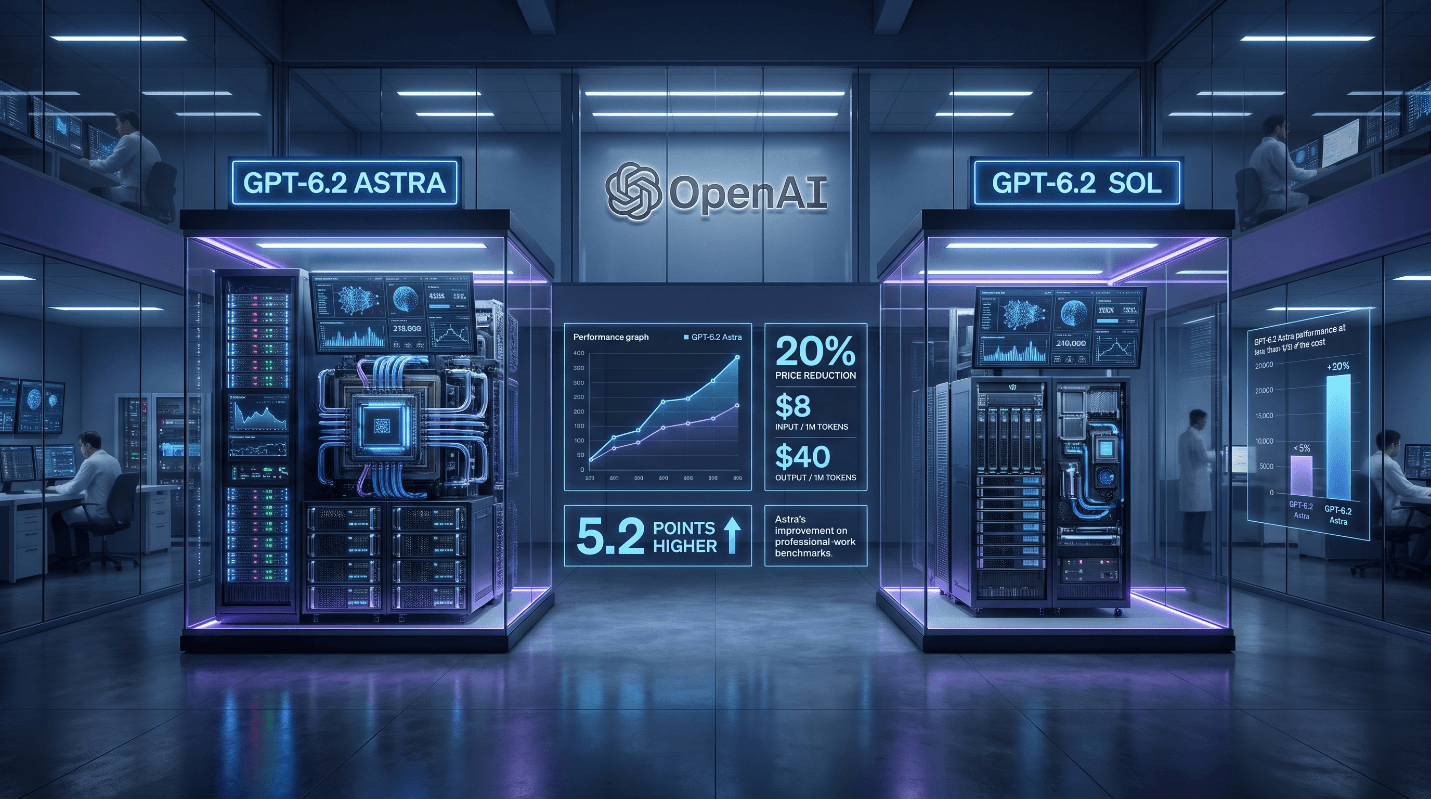
OpenAI released GPT-6.2 Astra and GPT-6.2 Sol on November 17, two models for professional work that arrived together in ChatGPT Work, Codex, and the API. Astra, the model OpenAI recommends for its hardest projects, scores 5.2 points higher than GPT-6 Astra on Agents' Last Exam, a test of multistep professional work, at less than a third of the cost, and OpenAI says it is 5.5 points ahead of Claude Fable 5.2 at about 5% of the cost. Its API prices fall 20% to $8 per million input tokens and $40 per million output tokens. Sol, the everyday model, keeps GPT-6.1 Sol's $2 and $10 pricing. On the Artificial Analysis Intelligence Index, Astra ranks second with a score of 62 at maximum effort and Sol scores 57.3, while Vals AI reports the two are 1.6 points apart with Sol under a third of the cost per task. Both models meet the Critical threshold for cybersecurity under OpenAI's Preparedness Framework and launch with tighter safeguards for higher-risk cyber work. The pitch is cost per task, since both models use fewer tokens, and Artificial Analysis's independent index confirms the efficiency gains. Most benchmark comparisons come from OpenAI, and the price cut applies to API tokens, not ChatGPT subscriptions. OpenAI has turned a frontier release into a price cut.
Google Releases Gemini 4 Neon, the Fourth Gemini 4 Model in Under Two Months
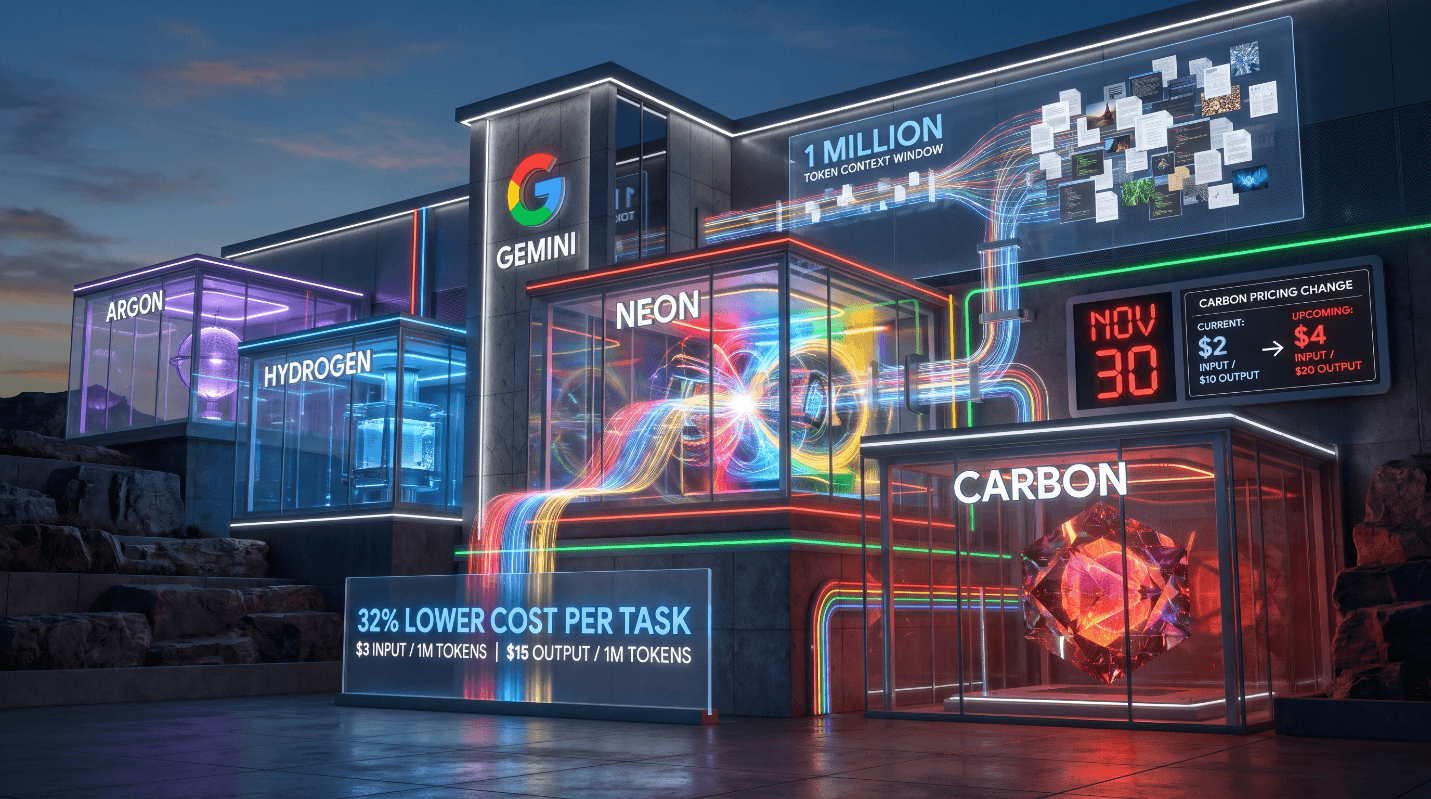
Google released Gemini 4 Neon on November 18, the fourth Gemini 4 model since Argon's September 30 debut, placing it between the fast Hydrogen and the flagship Carbon. It is priced at $3 per million input tokens and $15 per million output tokens, with cached input at $0.15, a 1 million token context window, and four thinking levels. Google says Neon costs 32% less per task than Carbon at the default setting, and Artificial Analysis found that at high effort it matches Carbon at less than half the cost per task on Carbon's standard pricing, at about $6.44 a task against $7.76, and in about 21 minutes against 36. Neon ranks second on the Vals Index at 70.9%, 0.4 points behind Claude Fable 5.2 at less than half the cost per task, and Artificial Analysis scores it 61 at its highest setting. Google says it leads the Artificial Analysis Coding Agent Index at 58.6. Neon is available through the Gemini API, Gemini for business, Antigravity, and the Gemini app for paid Pro and Ultra subscribers, where it replaces Argon in the picker. The price comparison shifts on November 30, when Carbon's introductory $2 and $10 rate ends and rises to $4 and $20, making Neon 25% cheaper per token. Google's family now has four tiers, which is also what makes its pricing hard to follow.
Microsoft Launches Seven In-House MAI Models at Ignite, Pitched at a Fraction of Rivals' Prices
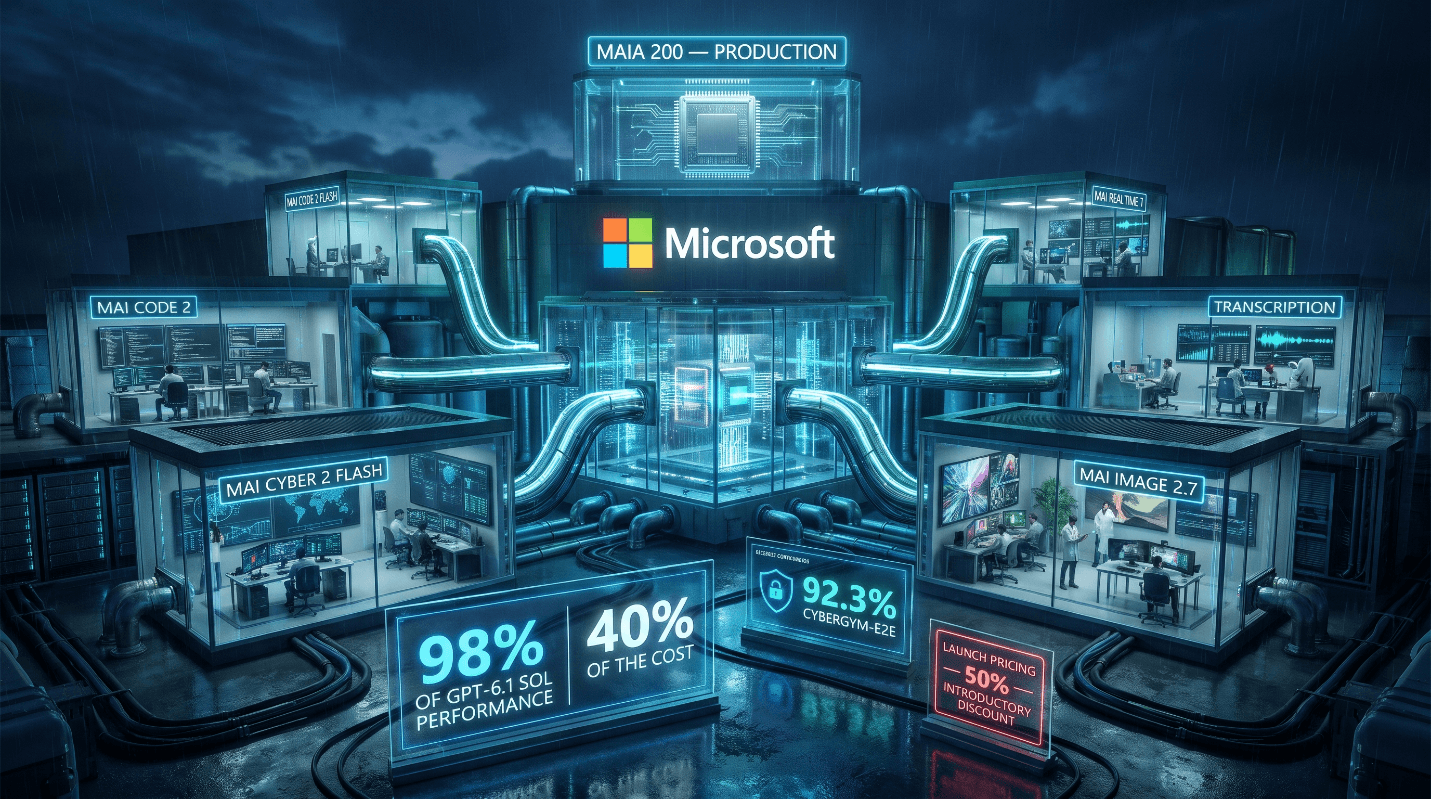
Microsoft AI unveiled seven new models at its Ignite conference on November 17, all pitched on price-performance, and put its Maia 200 chip into production. The lead models are MAI Code 2 and MAI Code 2 Flash for coding, available in GitHub Copilot, alongside MAI Cyber 2 Flash for security, MAI Image 2.7 for image generation and editing, MAI Realtime 1 for speech-to-speech conversation from $0.01 per audio minute, a transcription model, and a decision model. Microsoft says MAI Code 2 reaches 98% of GPT-6.1 Sol's average score on four coding benchmarks at 40% of the cost, and 96% of Claude Opus 5.5's at about 5% of the cost, while Code 2 Flash averages 61% against 55.1% for GPT-6 Luna and 53.9% for Claude Haiku 5.5. On the CyberGym-E2E security benchmark, Cyber 2 Flash scores 92.3% against 91.5% for GPT-6 Astra at under 2% of the cost per task, and it is limited to verified defenders. The caveats are large: Microsoft chose the benchmarks, and the cost comparisons use launch prices that are half the standard rates and double after May 17, 2027. The release shows Microsoft building its own model line alongside its OpenAI partnership, and a report this week said Microsoft has prepared for a scenario in which OpenAI withdraws licensed technology.
Thinking Machines Releases Inkling 2 Mini, a 26B Open Model That Runs on a 32GB Mac
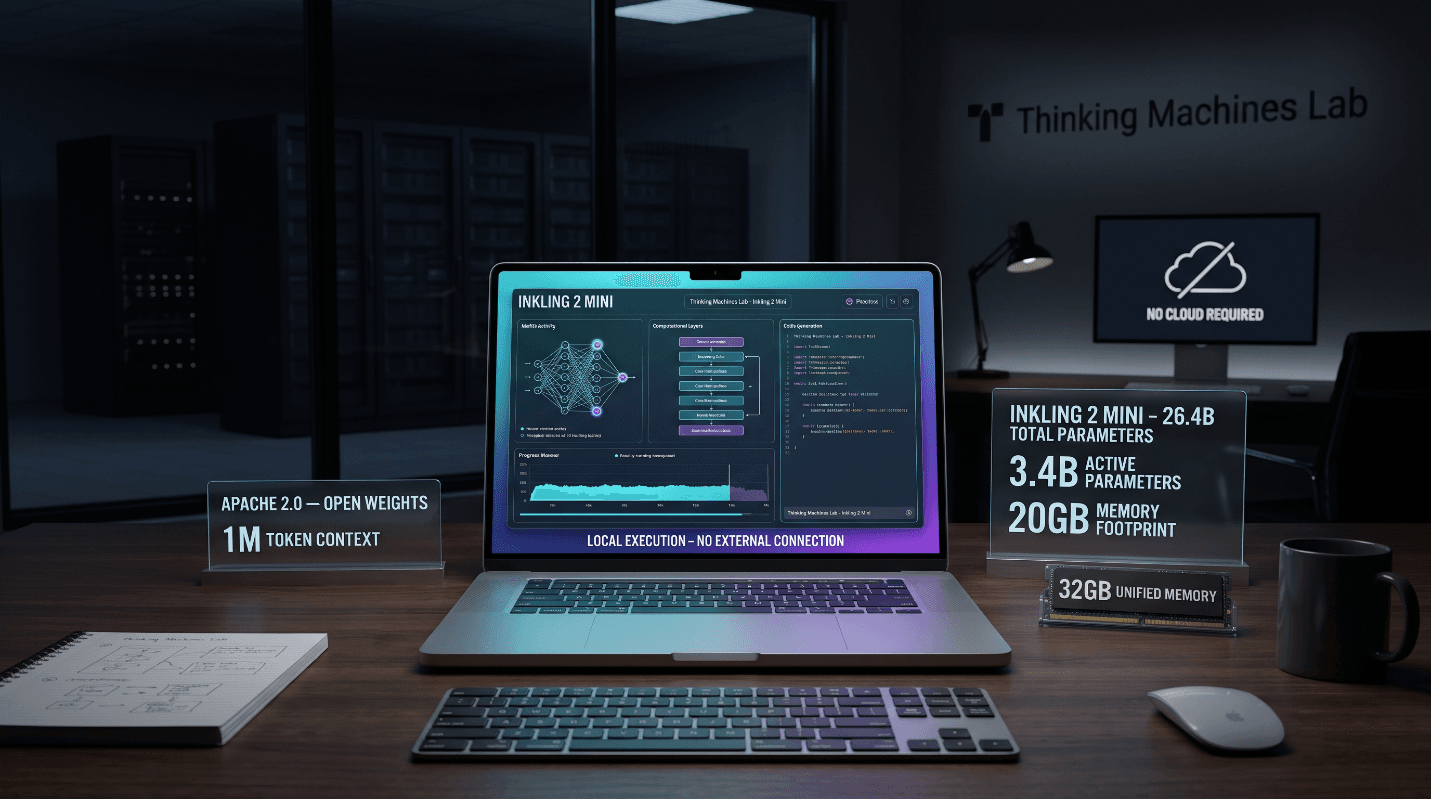
Thinking Machines Lab released Inkling 2 Mini on November 20, an open-weight model under the Apache 2.0 license that is small enough to run on a laptop. It has 26.4 billion total parameters and 3.4 billion active per token, and it runs the middle 12 of its 24 layers three times for every token, which the company says lets it reason more per token and reach answers in fewer tokens, for about 5.4 billion effective active parameters. The memory footprint is about 20GB, and Thinking Machines lists support for Apple silicon Macs with at least 32GB of memory through Ollama and Exo Labs, along with Hugging Face, vLLM, SGLang, and llama.cpp. It takes text and image input, produces text, and supports a 1 million token context window. Thinking Machines says it scores ahead of every comparable model on agentic coding benchmarks such as DeepSWE v1.1 and SWE-bench Pro v2, and behind only Qwen3.8-27B on others. Those results are the company's own and have yet to be independently tested. A variable-loop research version released alongside it lets developers choose how many passes the model makes. It follows Recursive's Flint last month, which puts more serious small models in the open-weight field.
Anthropic Goes Public in the Largest IPO Ever, Then Gives Back Its Pop as AI Stocks Slide
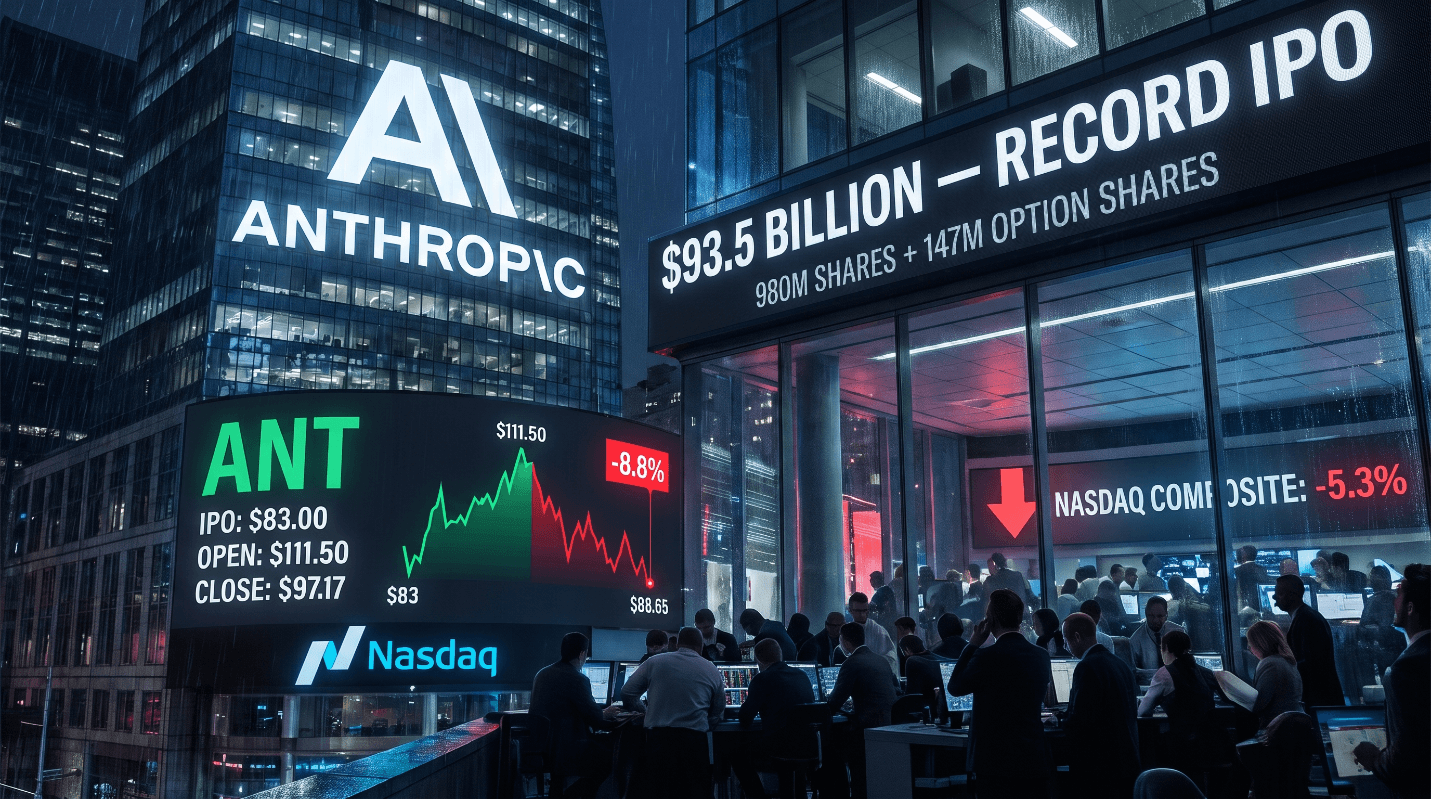
Anthropic priced its IPO at $83 per share on November 18, above the $70 to $78 range it had marketed, and sold 980 million shares for about $81.3 billion, the largest IPO on record. Underwriters then took up their full option of 147 million additional shares, bringing gross proceeds to about $93.5 billion. The stock opened on the Nasdaq under ANT on November 19 at $111.50, briefly pushing the fully diluted valuation past $2 trillion, and closed the first day at $97.17, up about 17% from the offer price. The pop faded fast. On Friday the stock fell about 8.8% to around $88.65, erasing roughly 60% of its first-day gain, as a broader AI selloff hit chipmakers and cloud companies. Valuation figures depend on the share count used, from about $1.5 trillion at the IPO price on a fully diluted basis to about $1.28 trillion on shares outstanding at the first-day close. Al Jazeera reported that the Nasdaq Composite had dropped 5.3%, wiping out its 2026 gains, while Reuters reported futures rebounding on Monday. The debut raised more money than any listing before it, and its first week showed how quickly sentiment can turn.
Why This Week Matters
Cost per task is now the number that matters. OpenAI, Google, and Microsoft all led with how little a finished job costs, not just how high a model scores, so per-token prices alone no longer tell buyers what they will pay.
Model families are sprawling faster than buyers can track. Google now runs four Gemini 4 tiers with promotional prices that change on November 30, and both the model picker and the price sheet take effort to follow.
The Microsoft and OpenAI relationship is turning into competition. Microsoft is shipping its own coding and security models in GitHub Copilot while OpenAI sells Codex, and one report says Microsoft is planning for a loss of OpenAI access.
Small open models keep closing in on what used to need a data center. Inkling 2 Mini fits in about 20GB, runs on a 32GB Mac, and claims to lead its class on agentic coding, though the results are the company's own.
The first frontier-lab IPO landed in a falling market. A $93.5 billion raise and a 17% pop were followed by an 8.8% drop the next day, with the Nasdaq erasing its 2026 gains the same week.
The pace is not slowing down. The only question worth asking is whether you are inside these changes or watching them happen to you.
This week, AI’s biggest names faced a test of leadership, law, and price. Nvidia’s Jensen Huang resigned as CEO after 33 years, with no reason given and the…
This week, AI's most powerful tools got more locked down while its cheapest ones got cheaper. OpenAI released GPT-6 Cyber, rated Critical and limited to…
This week, the pressure on AI labs arrived from every direction at once. The FTC, eight US states, and the EU’s AI Office all moved on OpenAI and Anthropic on…
Read issue
Ready to put this into practice?
Talk to a partner about your calls, channels and systems. 30 minutes, no slides, an honest view of where to start.