AI News7 min read
When a Bank Saves 90% on AI, Who Sets the Price?
This week, AI's most powerful tools got more locked down while its cheapest ones got cheaper. OpenAI released GPT-6 Cyber, rated Critical and limited to…
Read issue


This week, a college student built a tool that fact-checks politicians before they finish their sentence using nothing but a laptop and a few AI APIs. OpenAI delivered its first custom-built chip to Sam Altman in person, designed in just nine months. SpaceX kept turning a rocket company into the world's most unusual cloud provider, signing its third multi-billion-dollar compute deal in weeks. We learned a satellite quietly became an autonomous analyst back in April and nobody outside a small circle knew until now. And OpenAI closed the book on GPT-4.5, the model that once felt like the future. This was the week AI stopped looking like software and started looking like infrastructure, hardware, and habit, all at once.

A college student released InTruth, a free Chrome extension that listens to any live debate, press conference, town hall, or interview, transcribes the audio in real time, and checks every factual claim against authoritative sources before the speaker finishes their sentence. Built using the Claude API for verification, Deepgram for transcription, and Serper for live search, the extension assigns each claim to the correct speaker and classifies it as True, Substantially True, False, Misleading, or Unverifiable, deliberately skipping opinions, predictions, and rhetorical statements that can't be factually settled. A viral X post describing it as a tool that closes "the delay between the lie and the fact-check" pushed InTruth past 6,000 installs within days, holding a 4.0-star rating across its first wave of reviews on the Chrome Web Store.
It currently works on YouTube livestreams and select platforms, with the developer noting that transcript data is sent directly to the user's own chosen AI provider rather than stored or sold. On GitHub, the developer revealed InTruth is part of a larger ongoing research project at their university, hinting that more capabilities are coming. Chrome-Stats flagged the extension as high-permission, since it can capture on-screen audio and content, a risk profile that comes with any tool built to listen to live video, not a sign of bad intent. What makes the story land isn't the novelty of fact-checking. It's the latency. Fact-checking has always happened hours or days after a claim is made, by which point it has already shaped the conversation. One student, using publicly available AI tools, closed that gap to seconds.
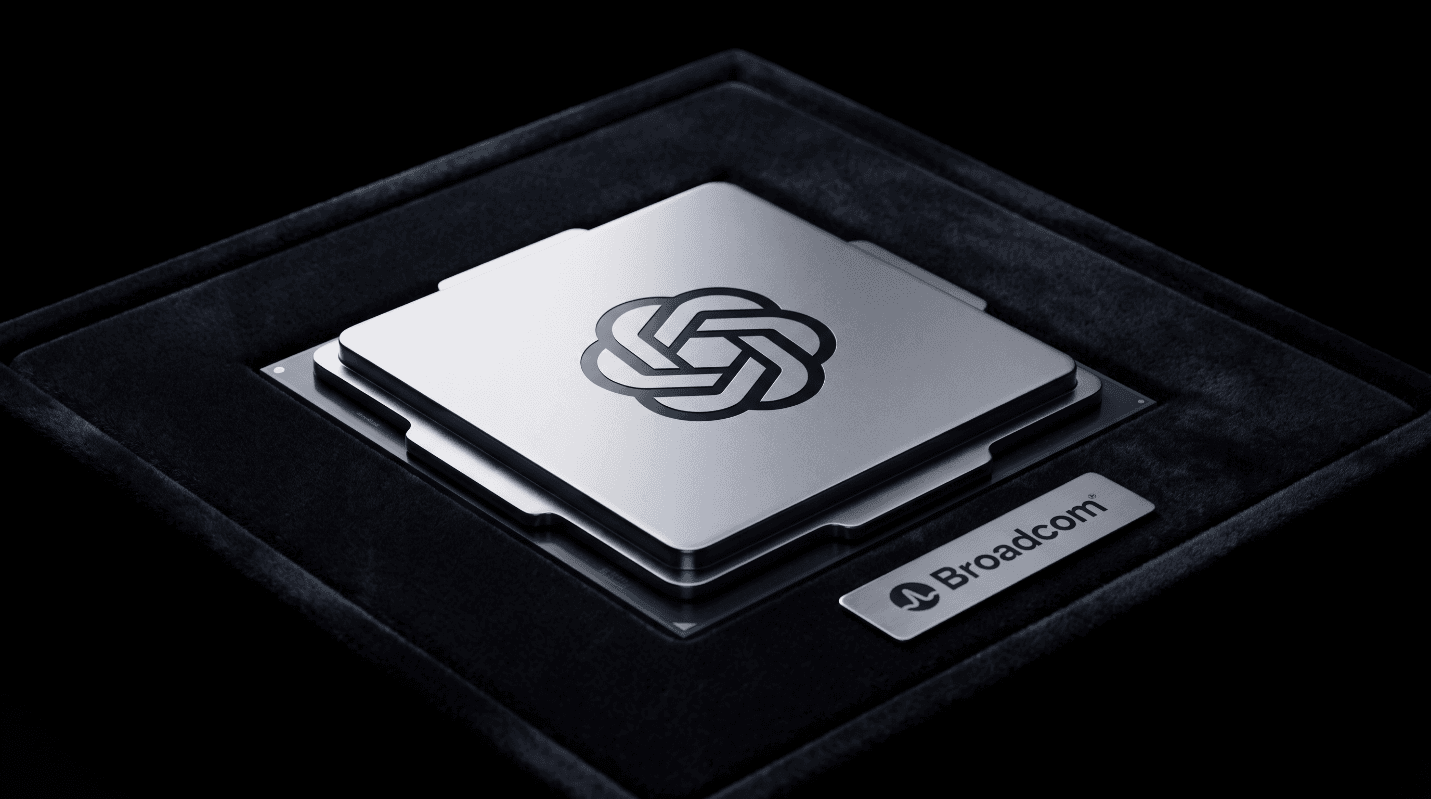
OpenAI and Broadcom unveiled Jalapeño on June 24, OpenAI's first custom-built chip, designed specifically for AI inference rather than training, and delivered in person to CEO Sam Altman and President Greg Brockman by Broadcom's leadership team. The chip went from initial design to manufacturing tape-out in just nine months, which OpenAI and Broadcom describe as the fastest ASIC development cycle ever achieved in high-performance semiconductors, sped up in part by using OpenAI's own AI models to accelerate the design and optimisation process itself. Early testing shows substantially better performance-per-watt than current state-of-the-art chips, particularly for real-time coding models, though OpenAI has not yet published full benchmark numbers.
Jalapeño is built purely for inference running already-trained models to answer user queries, while training workloads will continue to rely on NVIDIA hardware for now. The chip is the first step in a multi-generation compute platform OpenAI and Broadcom are building together, with initial deployment targeted for late 2026 and gigawatt-scale data centres planned with Microsoft and other partners. For OpenAI, the timing matters beyond the hardware itself: building its own silicon, alongside its pending IPO, signals to investors that the company is working to control its own costs rather than remaining fully dependent on NVIDIA's pricing and supply.
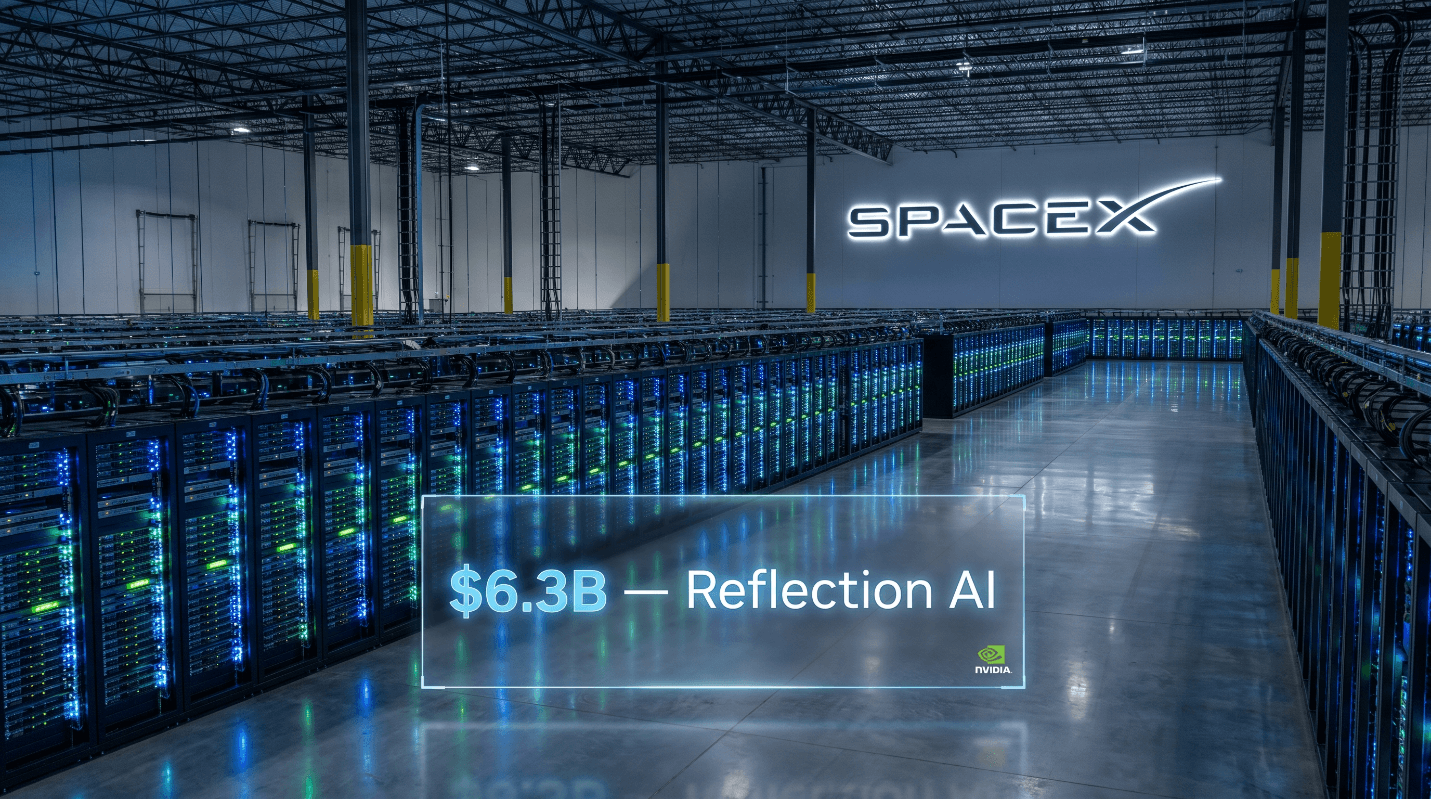
SpaceX signed a computing power deal worth up to $6.3 billion with Reflection AI, an open-source AI startup founded by two former Google DeepMind researchers, marking the third major compute deal SpaceX has struck since its record-breaking IPO closed on June 12. Under the agreement, Reflection will pay SpaceX $150 million per month starting July 1, 2026, for access to NVIDIA GB300 chips at SpaceX's Colossus 2 data center in Memphis, Tennessee with either side able to exit after 90 days' notice once the first three months pass. The deal brings SpaceX's total committed compute revenue from outside clients to more than $80 billion, following earlier agreements with Anthropic (roughly $45 billion) and Google (roughly $30 billion). Reflection, valued at $25 billion and backed by an $800 million NVIDIA investment, is building open-weight models for what it calls "American open intelligence," with active ties to the Department of Energy's Genesis Mission and Pentagon AI programs. A Reflection spokesperson directly cited the Fable 5 shutdown as validation for going open-source, saying recent events highlight the risks of depending entirely on closed AI providers. The deal creates an unusual loop: NVIDIA is simultaneously an investor in Reflection and the supplier of the exact chips Reflection will now rent from SpaceX. What started as a rocket company's side hustle in selling spare AI compute has, in under three weeks, become one of the most active deal-makers in frontier AI infrastructure.

In April, a satellite called YAM-9, built by space infrastructure company Loft Orbital, became the first spacecraft reported to run a vision-language model in orbit using Google DeepMind's open-weight Gemma 3 model to answer natural-language questions about Earth imagery without sending a single raw pixel back to the ground first. The achievement only became public on June 15, when TechCrunch reported the details: NASA's Jet Propulsion Laboratory built the onboard software harness, called NAVI-Orbital, that stripped Gemma 3 down to fit the satellite's limited memory, running on an NVIDIA Jetson Orin AGX chip. Researchers asked the satellite to classify land where nature meets development, or to spot infrastructure near railway hubs, and it answered in plain English, on its own, from orbit. Traditionally, Earth observation satellites work like dumb cameras: capture everything, beam it down, and let human analysts sort through the pile for hours or days. YAM-9 skipped that entirely, becoming what Loft Orbital's head of AI called the first step toward "always-on, patrol layers in space." Loft currently runs 12 satellites and estimates it would take 50 to 100 of similar capability to deliver real-time AI coverage of anywhere on Earth. Rivals Planet Labs and Kepler Communications are racing toward the same capability. It's a quiet, easily overlooked story with a genuinely wild headline: artificial intelligence is no longer confined to data centers. It's already in space, working without a human watching.

GPT-4.5 was permanently retired from the ChatGPT consumer interface on June 27, 2026, marking the end of a 30-day sunset period OpenAI announced in its May 28 release notes. Any existing conversations that were running on GPT-4.5 have automatically migrated to GPT-5.5, OpenAI's current flagship model, with no action required from users. The retirement is purely a consumer-app change. OpenAI's API continues to support GPT-4.5 separately for developers who have built production systems around it, giving them more time before they're forced to migrate. GPT-4.5 launched in early 2025 to genuine excitement as one of the largest models OpenAI had shipped at the time, and for many casual users, it was their first real exposure to a noticeably more capable AI assistant. Its retirement isn't a controversy or a technical story; it's simply the natural lifecycle of AI products accelerating to match how fast the underlying models are improving. What once felt like the cutting edge eighteen months ago is now considered legacy enough to be quietly switched off and forgotten by most users without a second thought.
A college student building InTruth alone, using public APIs, is the same story the AI industry keeps proving on repeat: the barrier to building something genuinely useful has collapsed. A tool that would have needed a small engineering team and a research grant two years ago took one person and a laptop. The capability is no longer the scarce resource. The idea, and the will to ship it, increasingly is.
OpenAI building its own chip is a bet that controlling the full stack matters more than staying flexible. Google and Amazon made this move years ago with TPUs and Trainium. OpenAI doing it now, just weeks before an IPO, sends a specific signal to investors: the company is trying to lower its own costs rather than stay permanently dependent on NVIDIA's pricing. Whether Jalapeño actually delivers on its performance claims will be one of the more consequential open questions of the back half of 2026.
SpaceX's third compute deal in weeks confirms that selling AI infrastructure has become more lucrative, faster, than anyone expected. A rocket company is now competing with AWS, Azure, and Google Cloud for AI compute customers and winning multi-billion-dollar contracts in days, not years. Reflection AI explicitly citing the Fable 5 shutdown as a reason to bet on open models is the more interesting subplot: regulatory uncertainty around closed AI is now a competitive advantage for open-source labs.
A satellite running an AI model in orbit for two months before anyone outside a small circle knew is a reminder that the most important AI developments aren't always the loudest. While the public conversation focused on chatbots, IPOs, and export controls, AI quietly crossed into space and started making decisions there without a human in the loop. That's the kind of story that looks unremarkable in the moment and looks foundational in five years.
GPT-4.5 retiring quietly is the most human story of the week. Eighteen months ago, it was the most capable model most people had ever used. Now it's gone, and almost nobody noticed. That's not a failure it's the clearest evidence yet of just how fast the baseline for "impressive AI" keeps moving.
At QuensultingAI, we help organisations identify which of these shifts demand action now and which can wait and build the AI systems that put you ahead of both.
The pace is not slowing down. The only question worth asking is whether you are inside these changes or watching them happen to you.
Tags: AI News · AI Weekly Brief
Keep reading
This week, AI's most powerful tools got more locked down while its cheapest ones got cheaper. OpenAI released GPT-6 Cyber, rated Critical and limited to…
Read issue

This week, the pressure on AI labs arrived from every direction at once. The FTC, eight US states, and the EU’s AI Office all moved on OpenAI and Anthropic on…
Read issue
This week, two frontier labs shipped cost-efficient answers to the same question: how do you deliver near-flagship intelligence without flagship pricing.
Read issue
Talk to a partner about your calls, channels and systems. 30 minutes, no slides, an honest view of where to start.
Talk to a partnerPrefer email? sales@quensultingai.com