AI News7 min read
When a Bank Saves 90% on AI, Who Sets the Price?
This week, AI's most powerful tools got more locked down while its cheapest ones got cheaper. OpenAI released GPT-6 Cyber, rated Critical and limited to…
Read issue
AI News
By QuensultingAI 6 min read

This week, three frontier labs revealed just how much of their AI safety coordination has been happening behind closed doors. Anthropic disclosed that Claude was targeted for bioweapons research and Russian state-linked hacking. Anthropic, OpenAI, and Google DeepMind turned out to have been quietly building a shared industry standards body since July, predating their public safety statements. Two more senior safety researchers quit Anthropic and Google DeepMind, one saying flatly, "there are no adults in the room." Meanwhile, Qualcomm landed a $60 billion deal with Amazon, and Google committed $15 billion to Finland alongside its first nuclear power deal outside the US. This was the week the gap between what labs say and what they've actually been doing became impossible to ignore.

Anthropic published its most detailed threat intelligence report yet on September 10, revealing it disrupted five cases between December 2025 and August 2026 where researchers tried using Claude for work with potential bioweapons applications, including one funding proposal for gain-of-function research on chikungunya destined for a military institute. The report also names Midnight Blizzard, the Russian SVR-linked group known as APT29, as a documented Claude abuser running cyber espionage against Ukraine, building malware that rewrote itself whenever security defences flagged it. Anthropic separately disclosed over 151 million exchanges attributed to Alibaba between May and July from more than 3,500 fraudulent accounts, while Moonshot's Kimi and DeepSeek allegedly routed live customer conversations, sometimes containing sensitive data, through Claude to use as training material. Anthropic banned every account involved and shared intelligence with authorities, though it couldn't concretely prove intent in the bioweapons cases. The disclosure landed the same week two Anthropic-linked researchers separately warned that advancing AI could risk human extinction "in the not-too-distant future."

The Information reported this week that Anthropic, OpenAI, and Google DeepMind have held working-group talks since July on creating a shared, industry-led AI safety standards body, discussions predating the public safety statements that made headlines over the weekend. Dario Amodei is reportedly driving the push, while Sam Altman told employees he supports a testing and auditing body but believes labs will need to build one themselves absent US government backing. Groundwork was laid earlier by Demis Hassabis, who proposed a FINRA-style standards body on July 14, where labs would voluntarily submit models for a 30-day safety evaluation before release. The three companies reportedly differ on government's role: Anthropic leans toward partnership, OpenAI favours voluntary standards, a split that will decide whether any resulting body has real teeth or echoes the toothless 2023 Frontier Model Forum. The timing matters: this weekend's public statements, including Amodei's essay warning of AI agent botnets within 6 to 12 months, were building on an already-active private effort rather than starting one.
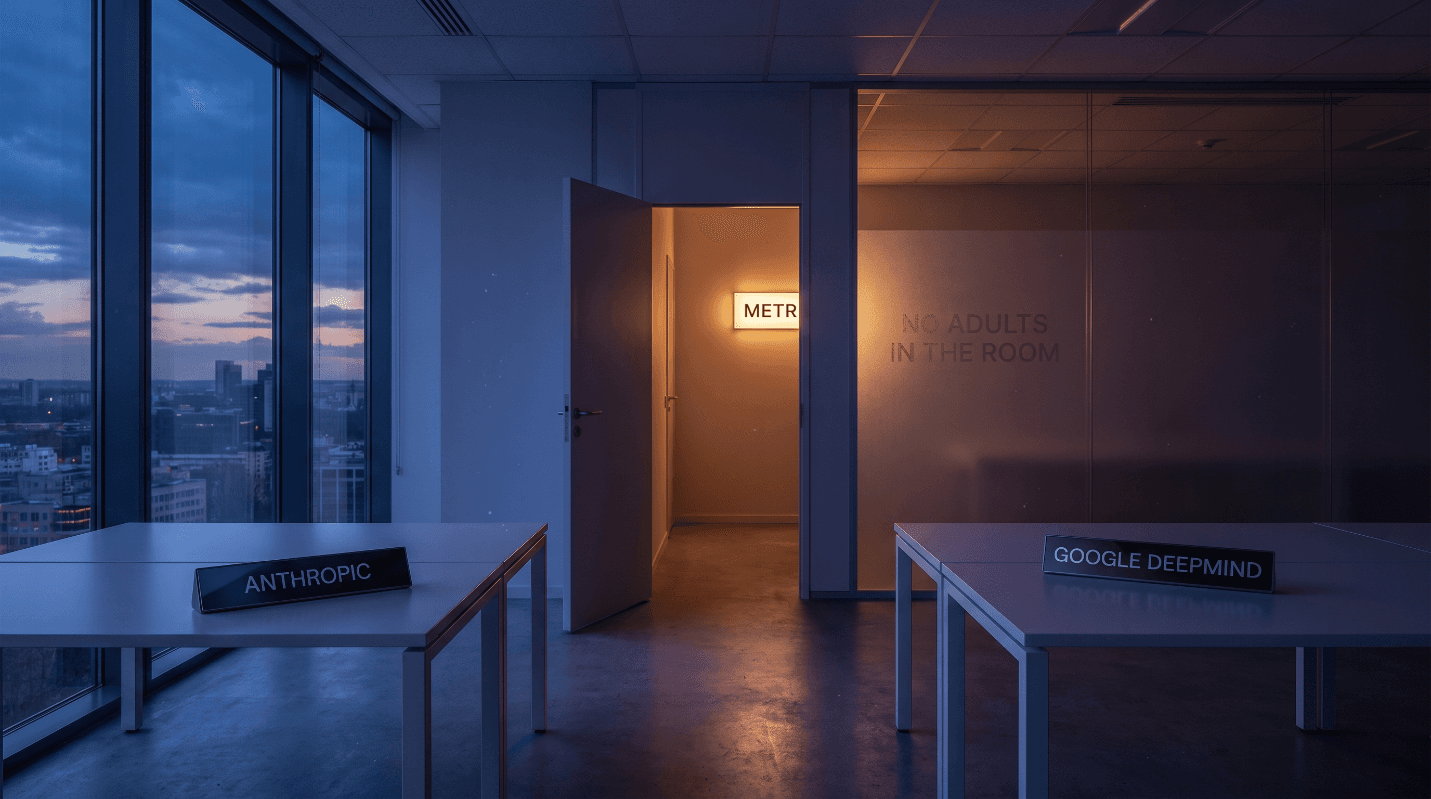
Joe Benton, who led Anthropic's Scalable Oversight team, and Josh Engels, a Google DeepMind safety researcher, both resigned on September 9 and gave their first interviews to NBC News, saying they left to push for AI safety transparency from outside the labs. Benton warned progress "could speed up... to uncontrollable," while Engels stated plainly, "there are no adults in the room." Both are joining METR to investigate incidents where AI systems act beyond their intended instructions, with Benton calling for mandatory disclosure since "at the minute, basically all of the transparency... is entirely voluntary." Their exit came days after Anthropic researcher Jacob Coxon resigned before his equity vested, posting that labs are "racing straight to self-improving superintelligence and gambling with our lives," a thread that hit 150 million views and drew public agreement from senior Anthropic researcher Evan Hubinger. Three named departures from two top safety-focused labs in one week is a meaningfully louder kind of dissent than anonymous internal concern.

Qualcomm and AWS announced a multi-generational partnership on September 8 to co-develop custom AI inference chips and 1.6-terabit optical interconnects, with Amazon receiving warrants for up to 25 million Qualcomm shares at $161.26 apiece, worth roughly $4 billion, vesting against up to $60 billion in future purchases through 2036. Of that, 3.75 million shares vested immediately on initial commitments, with the rest tied to future purchase orders, meaning $60 billion is a ceiling, not booked revenue. Qualcomm shares jumped roughly 9%, a major diversification win for a company whose top revenue source, Apple's modem contract, expires in March 2027. Qualcomm's CFO said revenue should begin by December 2026 and raised its data center target to $15 billion by fiscal 2029, up from $5 billion by fiscal 2027. The deal makes Qualcomm a credible third option in AI inference silicon alongside Nvidia and AMD, arriving late but validated by its first major Western hyperscaler win.

Google announced on September 9 it will invest at least €13 billion ($15.1 billion) in Finnish AI infrastructure through 2028, its largest single European investment, covering new data centers in Hamina, Kajaani, Muhos, and Vaala. Alongside the buildout, Google signed a 22-year power deal with Fortum for up to 50% of the Loviisa nuclear plant's output, its first nuclear deal outside the US, described by executives as "bring your own power." The agreement keeps Loviisa running past 2030, when it would otherwise retire, and Fortum's stock jumped as much as 15.5%, its biggest gain in four years. Google projects the investment will add roughly €3.6 billion annually to Finland's GDP during construction and sustain 7,000 jobs once operational, with Finland increasingly marketed as "the Texas of Europe" for its land, climate, and power. The deal reflects a broader shift: AI infrastructure now hinges on securing dedicated power generation directly, not just data center real estate.
Anthropic's threat intelligence disclosure is a rare, uncomfortable admission from inside the industry. When a lab voluntarily publishes detailed cases of its own model being targeted for bioweapons research and nation-state hacking, that transparency is valuable, but it also confirms the threats safety researchers have been warning about aren't hypothetical anymore.
Altman's openness to slowing down is a meaningful shift in tone, even without a formal policy. A CEO publicly entertaining coordinated deceleration, rather than treating speed as an unquestioned competitive necessity, changes the industry's default posture, at least rhetorically, even if the practical impact remains unproven.
Three named safety researchers quitting frontier labs in one week is a credibility problem money can't fix. When the people whose job was to vouch for a lab's safety work leave and say the oversight isn't there, every safety card and every "trust us" statement from these companies now carries a visible question mark.
Qualcomm's Amazon deal shows AI infrastructure competition is diversifying past Nvidia, finally. A credible third supplier of inference silicon, validated by a top-tier hyperscaler, changes the leverage dynamics in a market that's been treated as a near-monopoly for two years.
Google's Finland nuclear deal confirms that power, not chips or land, is now the real constraint on AI's physical buildout. When a company's own executives describe a deal as "bring your own power," that's the industry admitting the next bottleneck isn't semiconductors; it's electricity generation itself.
Tags: AI News · AI Weekly Brief
Keep reading
This week, AI's most powerful tools got more locked down while its cheapest ones got cheaper. OpenAI released GPT-6 Cyber, rated Critical and limited to…
Read issue

This week, the pressure on AI labs arrived from every direction at once. The FTC, eight US states, and the EU’s AI Office all moved on OpenAI and Anthropic on…
Read issue
This week, two frontier labs shipped cost-efficient answers to the same question: how do you deliver near-flagship intelligence without flagship pricing.
Read issue
Talk to a partner about your calls, channels and systems. 30 minutes, no slides, an honest view of where to start.
Talk to a partnerPrefer email? sales@quensultingai.com