
QuensultingAI
Content & Insights
Why Enterprise Chatbot Projects Fail and How to Fix It
Key takeaway: Most enterprise chatbot deployments underdeliver not because the technology is wrong, but because the architecture was never designed for enterprise complexity. Fix the architecture and the chatbot becomes a strategic asset. Skip it and you are budgeting for a maintenance problem.
Introduction: The Optimism Gap
Most enterprise AI chatbot initiatives begin with genuine optimism.
A vendor demo looks impressive. Leadership approves a pilot. The procurement team selects a platform. The IT team integrates what they can access. Six months later, the bot handles 12% of queries, escalation rates are high, and the project is quietly categorised as a partial success while everyone quietly agrees it underdelivered.
This story plays out across industries, across geographies, and across technology stacks. And in almost every case, the root cause is the same: it is not a technology problem. It is an enterprise chatbot architecture problem.
At QuensultingAI, we have spent more than a year working with enterprises across markets to untangle what goes wrong, and more importantly, to build conversational AI systems that actually deliver measurable business value. Here is what that work has taught us.
The Most Common Reason Enterprise AI Chatbot Deployments Underdeliver
The first mistake most enterprises make is treating chatbot deployment like a SaaS subscription: pick a platform, configure some intents, connect a knowledge base, go live, then wonder why containment rates are low.
The reality is that enterprise environments are too complex and too unique for cookie-cutter deployments.
Your data lives across CRM, ERP, HRMS, and a dozen legacy systems that were never designed to talk to each other. Your users span internal employees, channel partners, and customers, each with different access rights, different context expectations, and different definitions of a useful answer. Your compliance requirements may span DPDP, GDPR, SOC2, or industry-specific regulations that a generic platform vendor has never had to reason about.
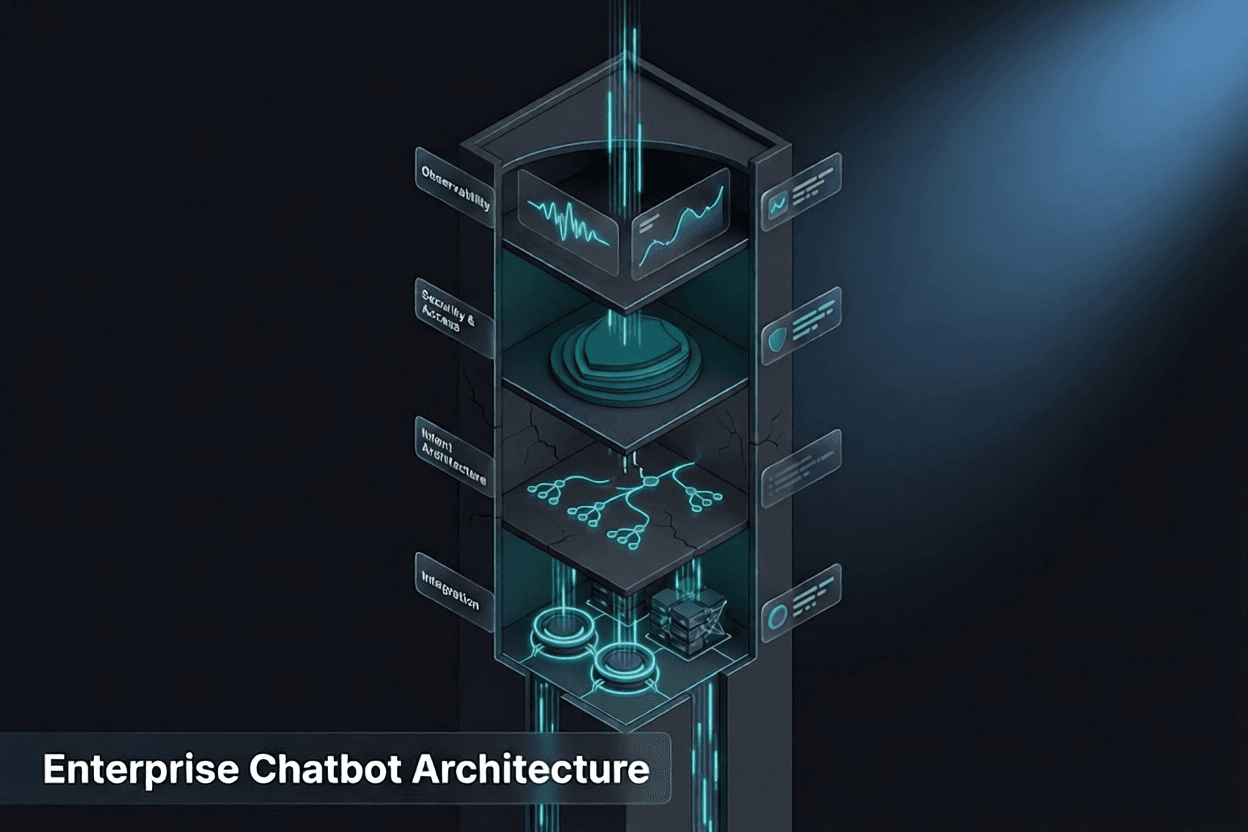
An off-the-shelf bot cannot be designed to handle all of this without deliberate architectural thinking from day one. If your enterprise chatbot is underperforming, the root cause is almost always one of four architectural gaps.
The Four Architectural Gaps That Cause Failure
1. Deep System Integration — The Bot That Cannot See Your Data
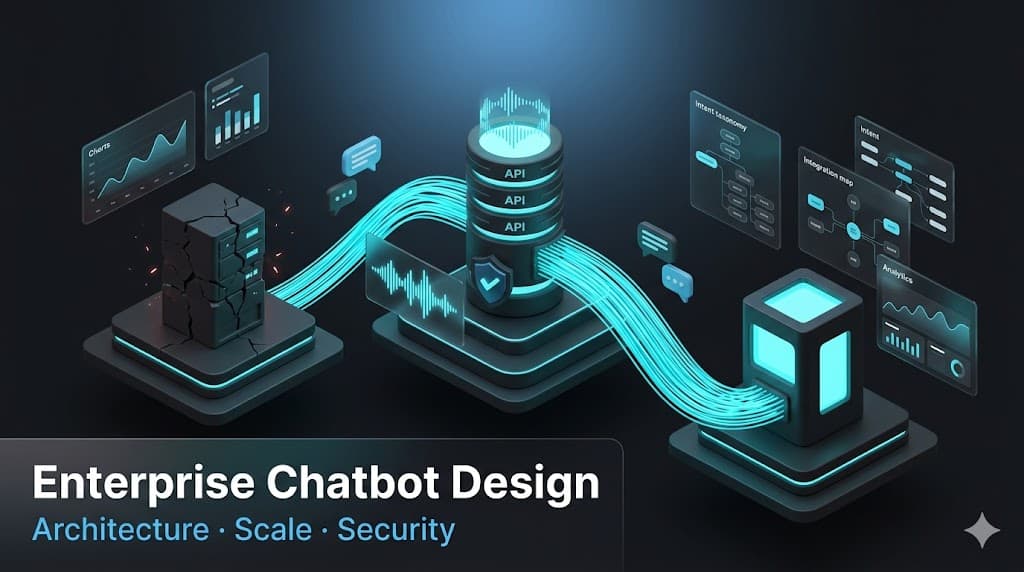
A truly useful enterprise chatbot is not a Q&A engine sitting on top of a document store. It is an orchestration layer that reads from and writes to live systems, retrieves real-time data, triggers workflows, and hands off to human agents with full context intact.
Getting this right requires clean API design, robust middleware, and careful thought about data flow and latency. Without it, your bot gives generic answers when users need specific, personalised ones. An employee asking about their leave balance should not receive an answer that starts with "Depending on your grade and location..." It should receive the actual number, pulled live from your HRMS, in the same turn.
2. Intent Architecture at Scale — The Bot That Cannot Navigate
Consumer bots handle tens of intents. Enterprise chatbots need to handle hundreds, often across multiple business functions, languages, and user personas. Getting this right requires a taxonomy-first approach where intents are grouped, disambiguated, and continuously refined using real conversation data.
It also requires fallback strategies that degrade gracefully rather than frustrating users with dead ends and "I didn't understand that" responses. Poor intent architecture is the single biggest driver of low containment rates, and it is the hardest problem to fix after launch.
3. Security and Access Control by Design — The Bot That Knows Too Much or Too Little
In an enterprise setting, not every user should receive the same answer to the same question. An employee asking about leave policy should get a personalised response based on their grade and location. A customer asking about account details should only see their own data.
Building this kind of contextual, role-aware response generation requires identity federation, token-based access control, and thoughtful session management, baked in from the start, not bolted on later. Retrofitting security is expensive and almost always incomplete. The audit finding that follows is expensive in a different way.
4. Observability and Continuous Improvement — The Bot That Cannot Learn
You cannot improve what you cannot measure. Enterprise chatbots need rich conversation analytics, intent confidence tracking, escalation pattern analysis, and feedback loops that inform continuous retraining.
This is not a reporting dashboard added after launch. It is a core part of the chatbot architecture. Enterprises that build observability in from day one improve containment rates significantly faster than those that treat it as an afterthought. The operational question is not "is the bot working?" but "where specifically is it not working, and why?"
Why Voice Bot Solutions Require a Separate Architecture Strategy
Voice bot deployments multiply the complexity of enterprise conversational AI. In addition to everything above, you now have to reason about:
- Speech recognition accuracy across accents, dialects, and ambient noise environments
- Turn-taking and interruption handling that feels natural in spoken conversation
- Latency thresholds that are measured in fractions of a second, not seconds
- DTMF fallback for legacy telephony infrastructure that your organisation cannot retire overnight
- Emotion detection and escalation triggers, because a frustrated caller who receives a robotic response at the wrong moment is a lost customer and a reputational event
The enterprises that get voice bot deployment right treat it as a distinct channel with its own UX design principles, not simply a spoken version of the text bot. If your organisation is planning a voice bot initiative, a voice-specific architecture review before platform selection is not optional, it is the investment that determines whether the project delivers.
The Pre-Deployment Review That Changes Everything
One of the most impactful engagements we run at QuensultingAI is a pre-deployment enterprise chatbot architecture review.
Before a single line of bot code goes into production, we assess the integration landscape, the intent taxonomy, the data flows, the security model, and the operational runbook. In almost every case, we find assumptions that would have become expensive problems six months later: an integration dependency that the vendor had not disclosed, an intent overlap that would cause systematic misrouting, a data access pattern that compliance would never sign off on.
This kind of chatbot design consultancy is not about slowing things down. It is about building fast in the right direction, so that your enterprise AI chatbot becomes a strategic asset rather than a maintenance burden. A well-architected enterprise chatbot typically reaches production in 12 to 20 weeks. Projects that skip the architecture review frequently take longer and deliver less.
Building Enterprise Chatbots for the Long Term
The best enterprise chatbots are not built once and forgotten. They are living systems that evolve as business processes change, as new backend systems are integrated, and as user behaviour reveals new patterns.
The architecture needs to support this evolution explicitly: modular intent libraries that let business teams add capability without rebuilding the foundation, versioned model deployments that allow rollback without downtime, and governance frameworks that let subject-matter experts contribute to bot training without needing a data scientist in the loop every time.
This is the difference between an enterprise chatbot that is relevant in three years and one that is quietly decommissioned after eighteen months because it is easier to start again than to maintain.
The single most valuable investment your enterprise can make upfront in a chatbot or voice bot initiative is not in the technology platform. It is in getting the architecture right from the start.
That is what we do.
Talk to us about your enterprise chatbot →
Frequently Asked Questions
Poor architecture planning rather than technology limitations. Enterprises that skip intent taxonomy design, system integration planning, and security by design end up with bots that cannot scale, cannot personalise, and cannot be maintained efficiently.
An enterprise chatbot must handle hundreds of intents across multiple user types, integrate with live backend systems like CRM and ERP, enforce role-based access control, and include analytics for continuous improvement. Standard consumer bots are not designed for this level of complexity.
A voice bot handles conversational AI over speech channels, including phone, IVR, and smart devices. It requires additional considerations around speech recognition accuracy, latency, emotion detection, and telephony integration that do not apply to text-based chatbots.
A well-architected enterprise chatbot typically takes 12 to 20 weeks for an initial production deployment, depending on the number of integrations and the complexity of the intent library. Rushing this timeline without proper architecture review is the most common cause of underperforming deployments.
Yes. While we are headquartered in Pune, we work with enterprise clients across markets on chatbot design consultancy, architecture reviews, and full deployment engagements. Visit deflect.in or contact us here to start the conversation.
Related links
- DPDP Act, Government of India
- GDPR Official Text
- SOC2 Overview — AICPA
- Retell AI Documentation
- Meta WhatsApp Business Platform
- NIST Cybersecurity Framework
- QuensultingAI Solutions
- Contact / Get Started
- deflect.in
- AI Automation for Sales India
- WhatsApp AI Bot Solutions
- AI automation services
- Voice AI bots
- WhatsApp AI bot
Ready to Get Started?
Let's discuss how voice AI can transform your business. Free consultation available.