Voice AI12 min read
How to Connect Retell AI to Your Tech Stack for Maximum ROI
Deploying a Retell AI voice agent is a genuine competitive advantage.
Read article
AI for SMEs
Discover how AI, BI dashboards, CRM, and WhatsApp automation, once exclusive to large corporates, are now affordable for Indian SMEs and MSMEs, and why smaller businesses are becoming their biggest competitors.
By QuensultingAI 13 min read
Published June 13, 2026 · 8 min read
Key takeaway: AI-powered business intelligence, CRM, and automation tools, once exclusively accessible to large enterprises, are now deployable by Indian SMEs and MSMEs at a fraction of the cost, in weeks instead of years. Combined with their natural agility, smaller businesses are poised to outcompete incumbents in ways that were simply not possible before.
For most of the last two decades, there was an unspoken but very real divide in Indian business: large corporates ran on data, everyone else ran on instinct.
Enterprises with deep pockets invested in ERP systems, enterprise CRMs, business intelligence (BI) platforms, and dedicated analytics teams. They could track customer behaviour in real time, automate follow-up communications, and make pricing or portfolio decisions backed by accurate, live data. The investment ran into crores, and it showed in their execution.
SMEs and MSMEs, meanwhile, managed operations through spreadsheets, accounting software exports, WhatsApp groups, phone calls, and hard-won experience. Not because owners lacked ambition or intelligence, simply because the tools were unaffordable, implementation timelines were impractical, and the technical expertise required was out of reach.
That divide is over.
The convergence of cloud computing, open-source AI frameworks, modern BI tools, and low-code integration platforms has collapsed the cost and complexity of building intelligent business infrastructure. What used to demand crore-level budgets and 18 months to deploy can now be built in weeks, without a large IT team, without enterprise licensing contracts, and without a single server in the building.
For India's 63 million+ SMEs and MSMEs, this is not a feature update. It is a structural realignment of competitive advantage.
To understand the significance of what's changed, it helps to understand the barriers that existed, and in many minds still exist.
Traditional BI platforms like SAP BusinessObjects, Oracle Analytics, or enterprise-tier Salesforce came with enormous annual licence fees alone, before factoring in implementation, customisation, and ongoing support. For a mid-sized business, committing that kind of budget to a software stack, with no guarantee of adoption, was simply not viable.
Enterprise tools assumed an in-house IT team, dedicated servers (or expensive cloud tenancies), and months of custom integration work. A mid-sized manufacturing or services business didn't have those resources, and couldn't justify hiring them for a single deployment.
As recently as 2020, deploying an AI voice agent or building a machine-learning model to analyse customer behaviour required data science expertise and significant computational investment. These were capabilities only the largest technology-forward companies could access.
None of these barriers exist in the same form today.
Modern AI and BI tools run entirely in the cloud, connect to existing data sources via APIs in hours (not months), and are priced on usage rather than flat enterprise licences. An SME pays for what it uses, scales when it needs to, and doesn't carry the overhead of infrastructure it hasn't grown into yet.
Large language models (LLMs) and pre-trained AI frameworks mean that building an intelligent calling agent, a WhatsApp chatbot, or a customer segmentation model no longer requires training a model from scratch. The heavy lifting has already been done. The work now is configuration and integration, which is an order of magnitude simpler and cheaper.
Modern BI dashboards, CRM platforms, and communication automation systems integrate directly with each other and with common business software: accounting packages, job management tools, e-commerce platforms, even spreadsheets. An SME doesn't need a custom integration team; the connectors already exist.
A BI dashboard showing real-time business performance can be live in two to three weeks. An AI calling agent integrated with a CRM can be deployed in two to three weeks. A WhatsApp automation workflow for lead follow-up can be running in days. The operational cost of getting started has dropped alongside the financial cost.
The businesses making the most of this shift are building a simple but powerful foundation across three layers:
A BI dashboard is the foundation of data-driven management.
Most SME and MSME owners make decisions based on instinct and memory, because the data that could inform those decisions is scattered across invoices, job sheets, WhatsApp messages, and accounting software that nobody has ever connected.
A well-configured BI dashboard pulls from every relevant data source and surfaces the metrics that matter: revenue by customer, product, or region; lead-to-close conversion rates; margin by job type; overdue follow-ups; operational bottlenecks. Not in a monthly report, but live, every morning, on a phone or laptop.
The business impact: owners and managers shift from reactive to proactive. They stop discovering problems after the fact and start spotting patterns while there's still time to act.
Typical build time: 2-3 weeks for a focused deployment
Speed of response is one of the highest-leverage variables in customer acquisition and retention.
Studies consistently show that responding to an inbound lead within the first five minutes increases conversion likelihood dramatically. Yet most SMEs, operating with lean teams, miss calls, delay follow-ups, and lose opportunities to competitors who simply responded faster.
AI voice agents now handle inbound calls, ask qualifying questions, capture information, and route the conversation, 24 hours a day, 7 days a week, without fatigue or inconsistency. The same logic applies to WhatsApp, where the majority of B2B conversations in India are initiated and managed. AI-powered WhatsApp automation handles follow-ups, quote reminders, job status updates, and re-engagement sequences, all triggered by workflows, all personalised, all consistent.
The business impact: every lead is caught. Every customer feels attended to. The sales and service team focuses on the conversations that actually require human judgment.
Typical build time: 2-3 weeks, including WhatsApp and data source integration
Learn more: Voice AI bots · WhatsApp AI bot
A CRM is only valuable if it reflects how the business actually works.
Generic enterprise CRMs arrive with hundreds of features a 60-person service company will never use, and often lack the specific stages, terminology, and workflow logic the business actually needs. The result is a system that nobody fully adopts, sitting half-configured alongside the WhatsApp groups and spreadsheets it was meant to replace.
A purpose-built lightweight CRM, configured around the specific pipeline stages, customer types, and operational workflows of the business, is a different proposition entirely. Every customer interaction is logged automatically. Every lead has a clear status. Every follow-up is tracked. The AI agents write to it and read from it. The BI dashboard draws its data from it.
The business impact: the business stops depending on the memory of individuals. Knowledge is institutional. New team members ramp up faster. Nothing falls through the cracks.
Typical build time: configured in parallel with the AI agent layer, with minimal additional lead time when part of an integrated deployment
See CRM integration for how we connect voice, chat, and CRM in production.
Here is the dimension of this shift that most analysts underweight: the competitive advantage of AI and BI is not just about the tools. It's about what happens when those tools are combined with the natural agility of a smaller business.
Large organisations adopting new technology face procurement approval, vendor evaluation, IT security review, data migration planning, change management workshops, a phased rollout, and months of user adoption work. What a 50-person company completes in six weeks can take an enterprise 18 months.
By the time the enterprise is live, the market has shifted. The smaller business has already iterated twice.
This asymmetry has always existed. What's new is that smaller businesses now have access to the same quality of operational intelligence that enterprises spent years building. The combination of enterprise-grade insight and SME-grade speed is one that large incumbents are structurally unable to match without fundamentally changing how they operate.
Consider what this looks like in practice:
The customers, who increasingly expect fast, responsive, personalised service, notice. And they respond accordingly.
India's SME and MSME sector is among the most dynamic in the world: 63 million businesses, contributing approximately 30% of GDP and nearly half of exports. Yet technology penetration within this sector has historically been limited.
The reasons are familiar: cost, complexity, language barriers, lack of local support, and a technology ecosystem built with enterprise customers in mind. The tools simply didn't fit the context.
That is changing rapidly.
AI models that understand and operate in Hindi, Tamil, Marathi, Bengali, and other regional languages are now commercially available. WhatsApp, already the default communication platform for B2B relationships across India, is increasingly the delivery channel for AI-powered business automation. BI tools that integrate with Tally, Zoho, and other India-native software are readily deployable. Local implementation partners, including QuensultingAI, are building and deploying these systems at SME-appropriate price points.
The Indian MSME that moves now is not playing catch-up with global best practice. In many respects, it is ahead of it, deploying AI-native infrastructure without the legacy systems and organisational habits that large multinationals are still trying to unwind.
Technology advantages have a shelf life. Early adopters gain ground; the tools commoditize; the advantage narrows as adoption spreads. This pattern has played out with websites, mobile apps, social media marketing, and cloud accounting software.
AI and BI adoption for SMEs and MSMEs is in the early-mover phase right now. The businesses that build this infrastructure in 2025 and 2026 will have two to three years of compound advantage before it becomes standard practice. They will have refined their workflows, trained their teams, built their data assets, and established the operational habits that make intelligent systems genuinely effective, while their competitors are still in the evaluation phase.
The question is not whether to adopt. The question is whether to be an early mover or a fast follower. And in markets where speed of response and quality of customer experience are the primary differentiators, being 18 months behind is not a recoverable gap.
If you are running an SME or MSME and the capabilities described in this article sound like what your business needs but you're not sure where to start, the answer is almost always the same: start with visibility.
Before automating anything, build the dashboard that tells you what's actually happening in your business. Which customers are most valuable? Which leads are converting? Where is time and money leaking? That clarity shapes everything else: what to automate, where to focus the AI agent, how to configure the CRM.
The entire foundation described in this article (BI dashboard, AI calling agent with WhatsApp integration, and a lightweight CRM) can be built and live within 30-90 days, at a cost that most SMEs and MSMEs will find well within reach.
The companies that will look back on this period as a turning point are the ones making that decision today.
More on
Tags: AI for SMEs · MSME Digital Transformation · BI Dashboard · AI Calling Agent · CRM for Small Business · WhatsApp Automation · Digital Transformation India · India
FAQ
Costs vary depending on scope, integrations, and complexity of your business workflows. Modern tools have made this accessible at a fraction of what enterprise deployments cost a decade ago. A conversation with us will give you a clear picture for your specific situation. Ongoing operational costs are typically modest relative to the initial build.
For a focused SME or MSME deployment, a BI dashboard can be live in 2-3 weeks, an AI calling agent in 2-3 weeks, and a full integrated stack within 30-90 days.
Yes, and WhatsApp is increasingly the primary channel for AI-powered customer communication in the Indian market. Automated follow-ups, quote reminders, lead qualification, and status updates can all be delivered via WhatsApp, integrated with your CRM and BI data. See our [WhatsApp chatbot India guide](/blog/whatsapp-chatbot-india-complete-guide-2026).
No. Modern tools connect to wherever your data currently lives, including spreadsheets, WhatsApp, Tally, or basic accounting software. You do not need an existing CRM or data warehouse.
Highly relevant for industrial and service businesses, often more so, because many have not yet captured the operational gains that technology-forward sectors have already extracted. Surface treatment, fabrication, facility management, logistics, and professional services businesses are among the sectors seeing the strongest return on AI and BI investment. ## Related on this site - [Top AI automation approaches for Indian SMEs](/blog/top-ai-automation-tools-india-sme) - [AI automation for sales in India: complete guide](/blog/ai-automation-for-sales-india-complete-guide-2026) - [How to build a WhatsApp AI bot in India](/blog/how-to-build-whatsapp-ai-bot-india) - [Hindi voice AI for customer support](/blog/hindi-voice-ai-customer-support-india) - [AI automation services](/solutions/ai-automation)
Keep reading
Deploying a Retell AI voice agent is a genuine competitive advantage.
Read article
Why Indian SMEs adopt n8n over Zapier and Make, self-hosted vs cloud options, and five workflows we deploy most: WhatsApp lead capture, voice-to-CRM, form qualification, order notifications, and onboarding triggers.
Read article
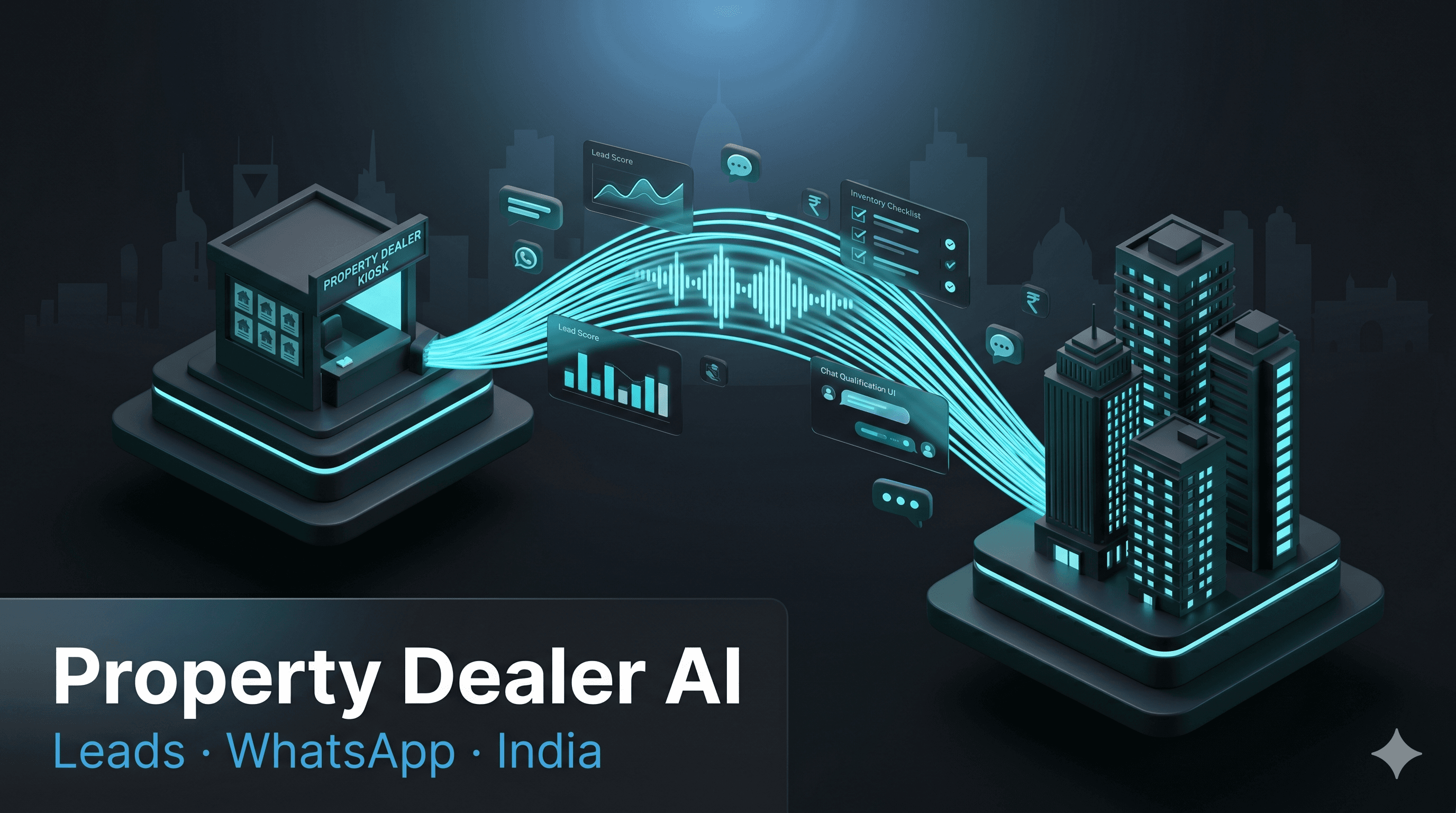
Channel partners and dealers: how to use voice + WhatsApp to qualify inventory-fit buyers and pass clean leads to RMs, with RERA-friendly messaging, no invented listings.
Read article
Talk to a partner about your calls, channels and systems. 30 minutes, no slides, an honest view of where to start.
Talk to a partnerPrefer email? sales@quensultingai.com