
Rajesh K Babbar
Content & Insights
AI Voice Agents for US Outbound Calling - The Complete Compliance Guide for 2026
The US has specific regulations governing AI voice calls. Getting compliance wrong means FCC fines and class action exposure. This guide covers TCPA, FCC, and FTC requirements.
Key takeaway: The US has some of the most specific regulations governing AI voice calls in the world. Getting this wrong means FCC fines, class action exposure, and campaigns being shut down. Getting it right means access to one of the highest-value AI automation markets globally.
- The three regulatory frameworks that govern AI calling in the US
- TCPA: what it means for AI voice agents
- FCC 2024 to 2026 AI calling rules
- FTC guidelines for telemarketing and AI disclosure
- What a compliant AI outbound campaign looks like
- The compliance stack for US deployment
- Frequently asked questions
Why US outbound voice compliance matters
The United States is the largest market for AI voice agent deployment globally. US businesses spend more per AI automation solution than Indian counterparts by a significant factor. For Indian AI automation companies, including QuensultingAI, serving US clients is a major growth opportunity.
But the regulatory environment for outbound calling in the US is complex, actively enforced, and changing rapidly as AI voice technology proliferates. The FCC updated its rules on AI-generated voices in 2024, and further guidance came in 2025. TCPA class action lawsuits are one of the most active areas of US consumer litigation.
This is not a space to approximate compliance. Here is what you need to know.
The three regulatory frameworks that govern AI calling in the US
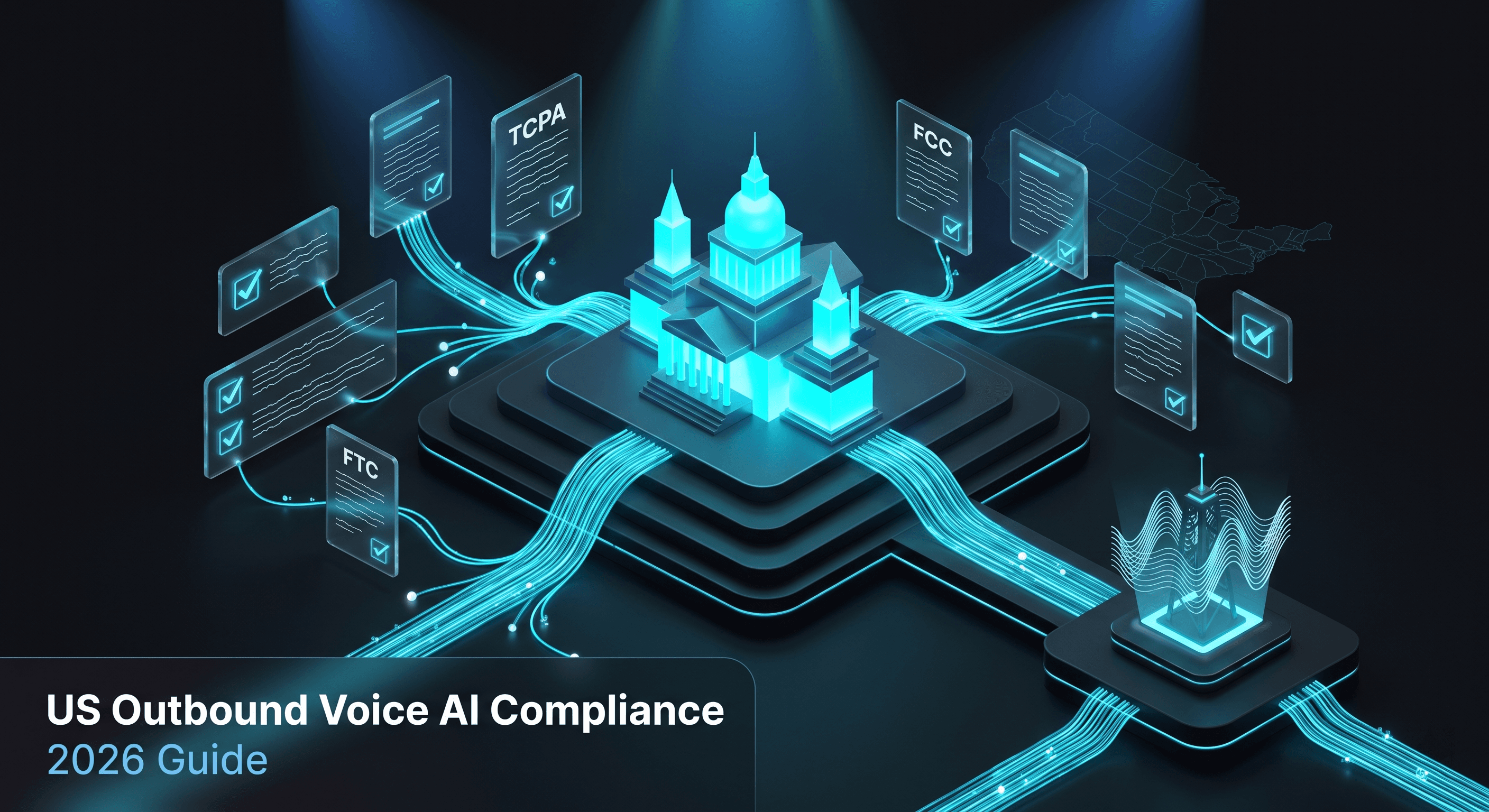
TCPA (Telephone Consumer Protection Act) governs what types of calls you can make to US consumers, consent requirements, and Do Not Call compliance.
FCC (Federal Communications Commission) rules include specific rulings on AI-generated voice calls, robocalls, and artificial voice disclosure requirements.
FTC (Federal Trade Commission) guidelines govern deceptive practices in telemarketing, including AI impersonation of humans.
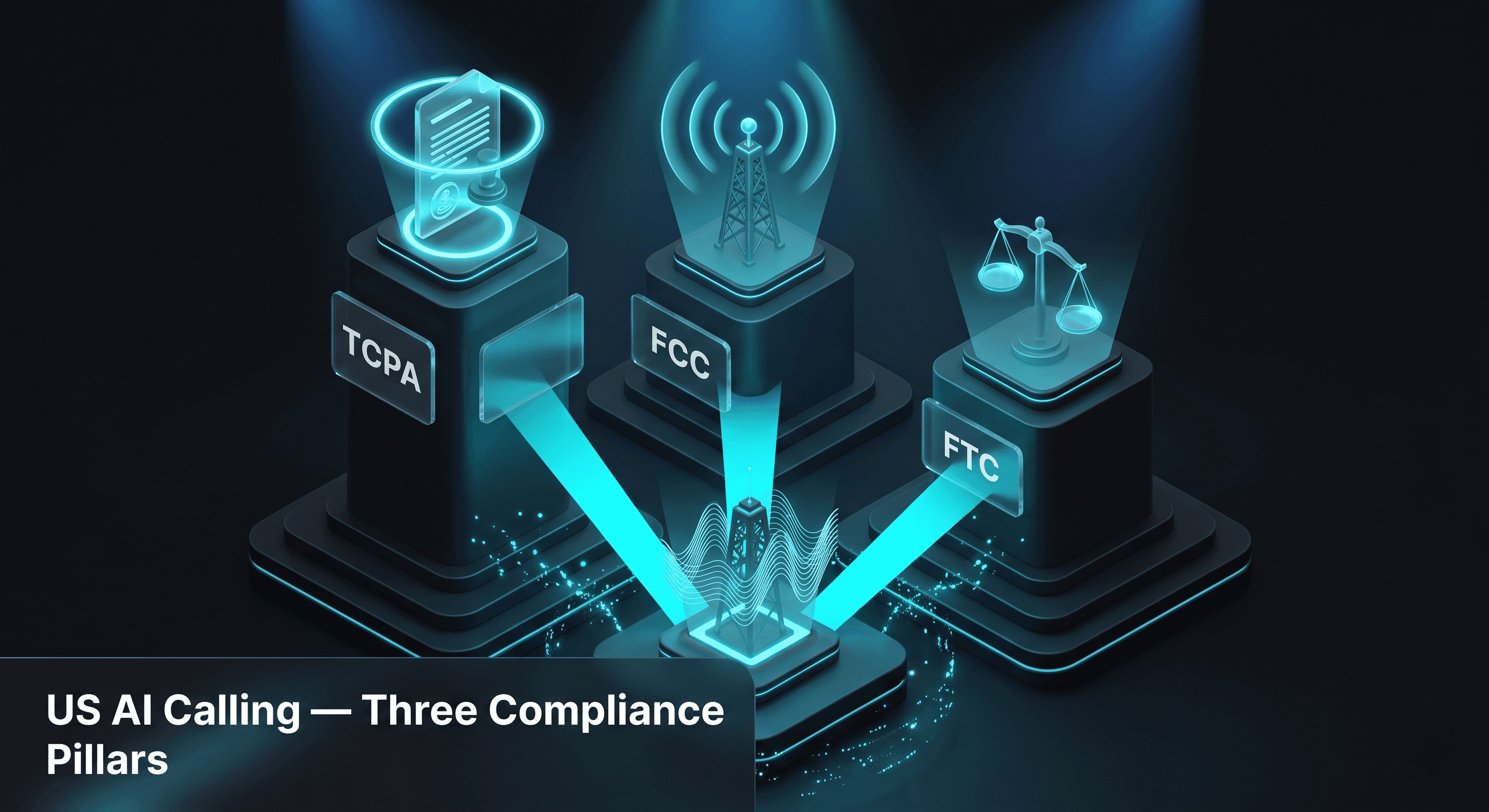
These three frameworks overlap. A compliant deployment must satisfy all of them, not just one.
TCPA: what it means for AI voice agents
The TCPA requires written consent before making autodialled or pre-recorded calls to mobile phones. The FCC's 2024 ruling clarified that AI-generated voice calls fall under the same pre-recorded call restrictions as traditional robocalls.
Key TCPA requirements for AI outbound calling:
- Written consent required for calls to mobile phones. The consent form must specifically reference automated calls and the company placing them.
- Do Not Call Registry compliance. All numbers must be scrubbed against the National Do Not Call Registry before each campaign.
- Company-specific Do Not Call list. You must maintain and honour an internal DNC list.
- Time restrictions. No calls before 8 AM or after 9 PM in the recipient's local time zone.
- Opt-out mechanism. Callers must be able to say "remove me from your list" and the AI must recognise and process this immediately.
FCC 2024 to 2026 AI calling rules
The FCC's February 2024 ruling explicitly classified AI-generated voices as "artificial voices" under the TCPA, closing a loophole that some marketers had attempted to exploit.
The most important practical requirements:
- Disclosure at call start. The AI must identify itself as an AI at the beginning of every call. This cannot be buried or delayed.
- No AI impersonation of government officials. Explicitly prohibited.
- Caller ID authenticity. The caller ID must reflect a number traceable to the actual business placing the call. No spoofing.
- Opt-out must be immediate. Saying "stop" or "remove me" must immediately trigger list suppression, not put the caller on a 30-day process.
FTC guidelines for telemarketing and AI disclosure
The FTC has published guidance that AI-powered customer interactions, including voice calls, that do not disclose they are AI may constitute deceptive trade practices.
For outbound voice AI, the practical implication is: your script must include, at the very first moment of the call, a clear statement that the caller is speaking with an AI. Something like: "Hi, this is Alex, an AI assistant from [Company Name]. I am calling about..."
The FTC also flagged that making it unreasonably difficult to connect to a human agent, or denying the ability to speak to a human when requested, may constitute a deceptive practice.
What a compliant AI outbound campaign looks like
A fully compliant US AI outbound calling campaign includes:
- Pre-campaign: Written consent capture, NDNC scrub, time-zone-aware scheduling
- Call start: Clear AI identity disclosure in the first three seconds
- During call: Human escalation option available at any point on request
- Opt-out processing: Immediate list suppression on any opt-out statement
- Post-call: Transcript and consent record stored for four years (TCPA statute of limitations)
QuensultingAI builds these controls into n8n workflows before every call batch fires. Consent records and opt-out flags sync to your CRM automatically.
The compliance stack for US deployment
At QuensultingAI, our US outbound deployments use a compliance architecture built on:
- Voice platform (Retell, Vapi, or Dograh) with configurable disclosure statement at call start
- Plivo or Twilio with STIR/SHAKEN-compliant telephony (required for US calls)
- n8n automation with NDNC scrub trigger before every call batch
- CRM integration for consent record storage and opt-out flag management
- Time-zone logic ensuring calls only fire within TCPA permitted hours in the recipient's local time
We do not recommend calling US numbers from unverified Indian-origin numbers. Calls must originate from a verified US number provisioned through a compliant carrier.
Frequently Asked Questions
The TCPA primarily covers consumer calls. B2B calls to business landlines have somewhat less restriction but FTC deceptive practices rules still apply, and AI disclosure is still required. Mobile numbers used for business have the same TCPA protections as personal mobile numbers.
Not without proper US telephony provisioning. Calls must originate from a verified US number to comply with STIR/SHAKEN. This requires a US Plivo, Twilio, or equivalent number.
Yes. The TCPA applies to SMS as well as voice. AI-generated SMS campaigns require the same consent and opt-out standards.
Retell, Vapi, and Dograh all support configurable opening disclosures and opt-out handling. The compliance architecture matters more than the platform choice. n8n pre-call scrubbing and CRM consent storage are non-negotiable regardless of platform.
TCPA litigation can look back four years. We recommend storing transcripts, consent records, and opt-out confirmations for at least that period.
Ready to Get Started?
Let's discuss how voice AI can transform your business. Free consultation available.