
QuensultingAI
Content & Insights
AI Restaurant Operations Platform: A Hospitality Case Study
Key takeaway: Hospitality revenue leaks in two quiet ways: after-hours calls that go unanswered, and post-visit feedback that never gets captured. This case study shows how one premium brand closed both gaps with a single AI voice platform and live dashboard.
Premium hospitality client, name withheld under NDA.
- The solution
- The guest communication loop
- Business impact
- Why this matters beyond one client
- Related reading
In hospitality, guest communication does not stop when the restaurant closes. Reservation requests, modifications, and cancellations still come in after hours. The feedback that matters most often arrives right after the visit, when nobody is at the front desk to capture it. Staffing around that clock gets expensive fast.
This case study looks at how one premium hospitality client automated guest communication end-to-end, from booking to post-visit follow-up, without adding headcount.
The Challenge
The client needed to automate guest communication around the clock: handling reservations, collecting post-visit feedback, and giving management real-time visibility into what was happening across all of it.
The constraint was the same one we see across most hospitality and restaurant operators. None of this could come at the cost of adding headcount. Every additional touchpoint had to be covered by automation, not by hiring more staff to answer phones and follow up after visits.
There was also a quality bar to hit, not just a coverage one. Guests expect a reservation call to feel personal, not scripted. A hospitality brand's reputation rides on that experience being consistent whether it is 2pm or 2am.
The Solution
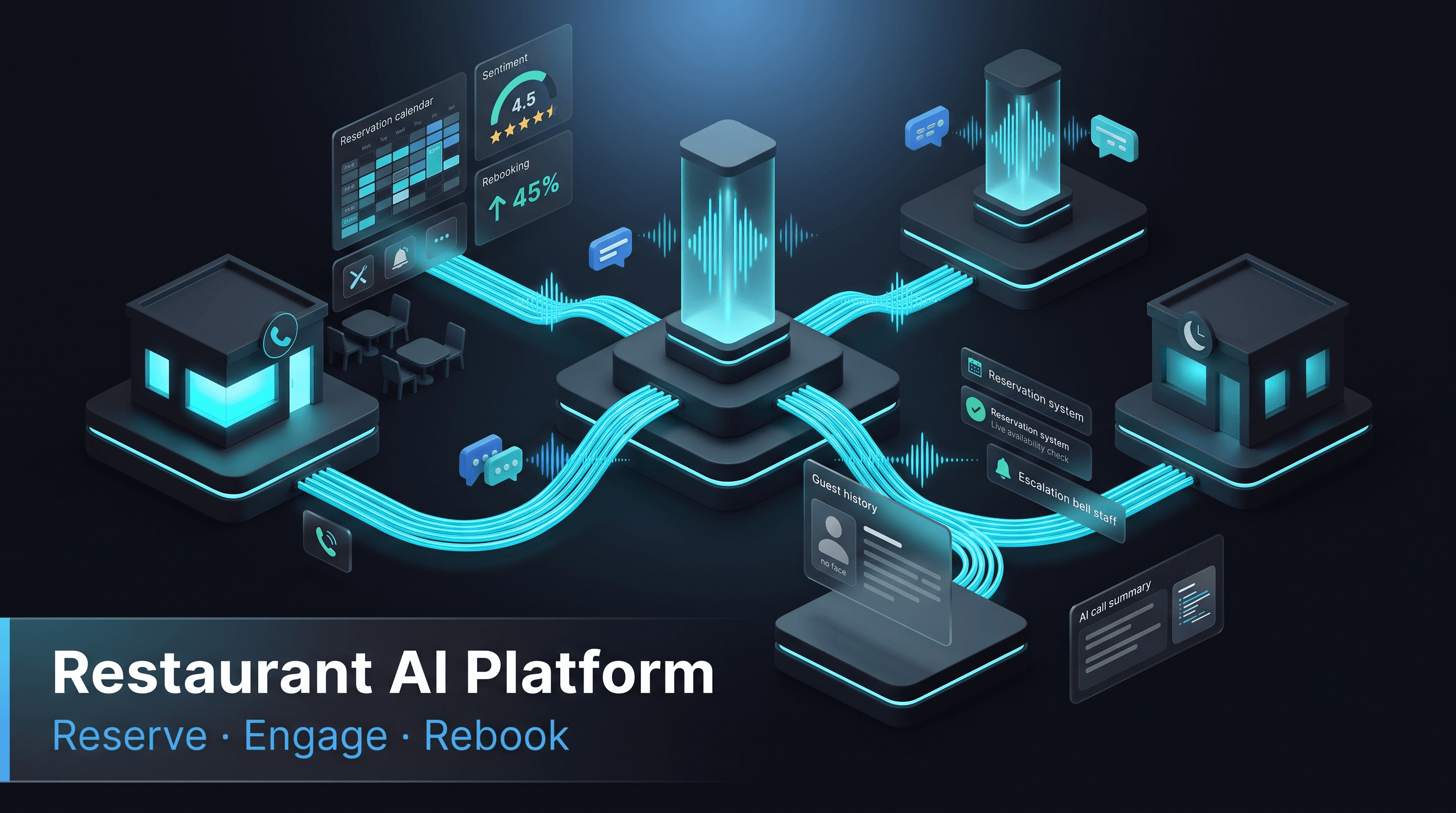
We built a fully integrated AI voice platform combining inbound and outbound agents, reservation system integration, automated guest engagement workflows, and a real-time management dashboard. The platform does not just answer the phone. It manages the full guest communication loop, before and after the visit.
Key Capabilities
24/7 reservation handling. The AI manages bookings, modifications, and cancellations with live availability checks, so guests get accurate answers whether they call during service or well after closing.
Personalized guest conversations. The system draws on guest history and prior bookings to tailor each interaction, recognizing repeat guests and referencing past visits instead of treating every call like a first-time inquiry.
Automated re-engagement. Post-visit feedback campaigns go out automatically, with rebooking incentives built into the outreach. That turns a one-time visit into a return booking without staff having to chase it manually.
Smart escalation and insights. Complex or sensitive requests route to staff rather than being forced through automation. Every call also generates an AI summary and sentiment analysis, giving management a readable record of how the interaction actually went.
The Guest Communication Loop
Reservations and post-visit engagement are one continuous workflow, not two separate projects:
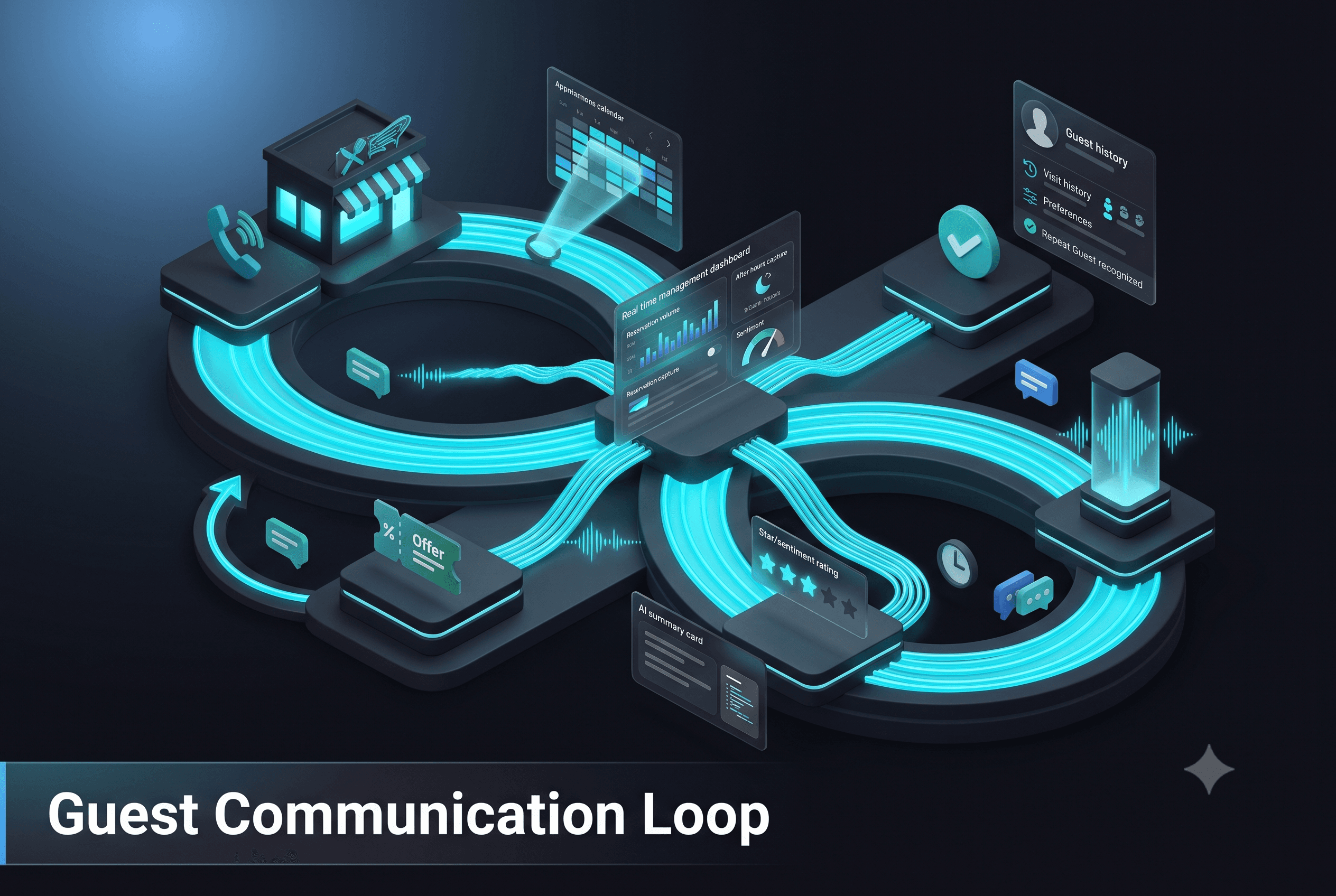
Before the visit: Inbound calls hit the AI voice agent, which checks live availability against the reservation system. Repeat guests are recognized from history. Modifications and cancellations update the system in real time. After-hours calls that would have hit voicemail now convert to confirmed bookings.
After the visit: Outbound agents trigger feedback collection automatically. Sentiment and summary data feed the management dashboard. Guests who respond positively receive rebooking incentives. Staff only get involved when the AI flags a sensitive or complex request.
For management: The dashboard shows reservation volume, after-hours capture rate, feedback scores, and rebooking conversion in one view. No one compiles call logs manually at the end of the week.
This mirrors the architecture we deploy for restaurant chatbot and hotels booking AI agent projects when voice is the primary guest channel.
Business Impact
As described by the client:
- Zero missed reservations: Booking opportunities outside business hours are captured instead of lost to voicemail.
- Elevated guest experience: Personalized interactions at every touchpoint, not just the ones a human happened to be available for.
- Reduced staff workload: Automation absorbs high-volume, routine requests, freeing staff for the interactions that need a human.
- Automatic insights: Actionable analytics generated from every interaction, rather than feedback that only surfaces when a guest complains directly.
Why This Matters Beyond One Client
Hospitality businesses lose revenue in two quiet ways: the after-hours call that goes unanswered, and the guest who had feedback worth acting on but was never asked.
This case shows a pattern that addresses both. An AI platform treats reservations and post-visit engagement as one continuous workflow, backed by a dashboard that gives management visibility without requiring anyone to manually compile it.
If you are considering this for your own operation, start with the same questions that shaped this build: which requests genuinely need a human versus which are routine enough to automate, how personalized does a returning-guest experience need to feel, and what would management actually do differently with real-time visibility into every call?
Related Reading
- AI Chatbot for Restaurant Operations India & US
- Hotels Booking AI Agent for Reservations and Guest Support
- WhatsApp AI Bot for Restaurants in India (2026)
Talk to Us
If after-hours calls and post-visit follow-up are slipping through the cracks, this is the exact problem our AI hospitality platform was built to solve. Get in touch for a free consultation.
Why this topic matters in production
Teams usually do not fail because the model is weak. They fail because ownership, escalation behavior, and integration quality are undefined when live traffic arrives. For voice and conversational AI operations, the production question is simple: when automation cannot complete an intent, does it route to the right human with enough context to act immediately? If this handoff contract is weak, quality drops even when volume appears healthy.
A strong operating model defines what should be automated, what should be escalated, and what data must be captured for every interaction. This keeps outcomes measurable and improves trust across revenue, support, and operations leaders for India operations with global delivery patterns.
Architecture and data contracts
Production systems should treat conversations as events that map to business records. Each successful or failed interaction should update CRM, ticketing, or campaign objects with structured dispositions and timestamps. Required fields, optional fields, and fallback defaults must be documented before launch.
Integration reliability is equally important. API latency, partial failures, and malformed payloads are expected in real systems. A durable design includes retries, queueing, and explicit fallback paths such as callback scheduling or escalation ticket creation.
90-day rollout framework
Days 1-30: launch narrow, high-volume intents with baseline KPI tracking.
Days 31-60: improve failure clusters, handoff quality, and data freshness.
Days 61-90: expand to adjacent intents only after governance gates are met.
This sequence protects quality while creating measurable progress. Expansion should pause when quality indicators regress.
KPI model and QA operations
Track intent-level outcomes rather than vanity totals: qualified outcomes, handoff acceptance, completion quality, and system-of-record freshness. Add weekly transcript sampling by intent and language cohort. Aggregate averages can hide severe quality failures in minority but business-critical workflows.
Quality reviews should be cross-functional: implementation owners, RevOps, support, and analytics operators. Every major change should have rollback criteria and before/after KPI comparison.
Common execution mistakes
- Over-automating sensitive intents in phase one.
- Ignoring data contracts and downstream field quality.
- Handoff without context or ownership.
- Mixing multiple campaign objectives into one score.
- Scaling before governance is stable.
Practical checklist
- Define top intents and exclusion intents before launch.
- Enforce structured dispositions in every completed flow.
- Keep escalation routes explicit and staffed.
- Maintain references and policy links for claims and guidance.
- Re-review failures weekly and publish change notes.
Related links
- Retell AI Documentation
- Retell AI documentation
- Meta WhatsApp Business Platform
- NIST Cybersecurity Framework
- FTC business guidance
- ITU statistics and digital development
- Restaurant chatbot use case
- Hotels booking AI agent
- Voice AI bots
- AI automation services
- WhatsApp AI bot
- CRM integration
- Outbound campaigns
- Use case library
Ready to Get Started?
Let's discuss how voice AI can transform your business. Free consultation available.