
Rajesh K Babbar
Content & Insights
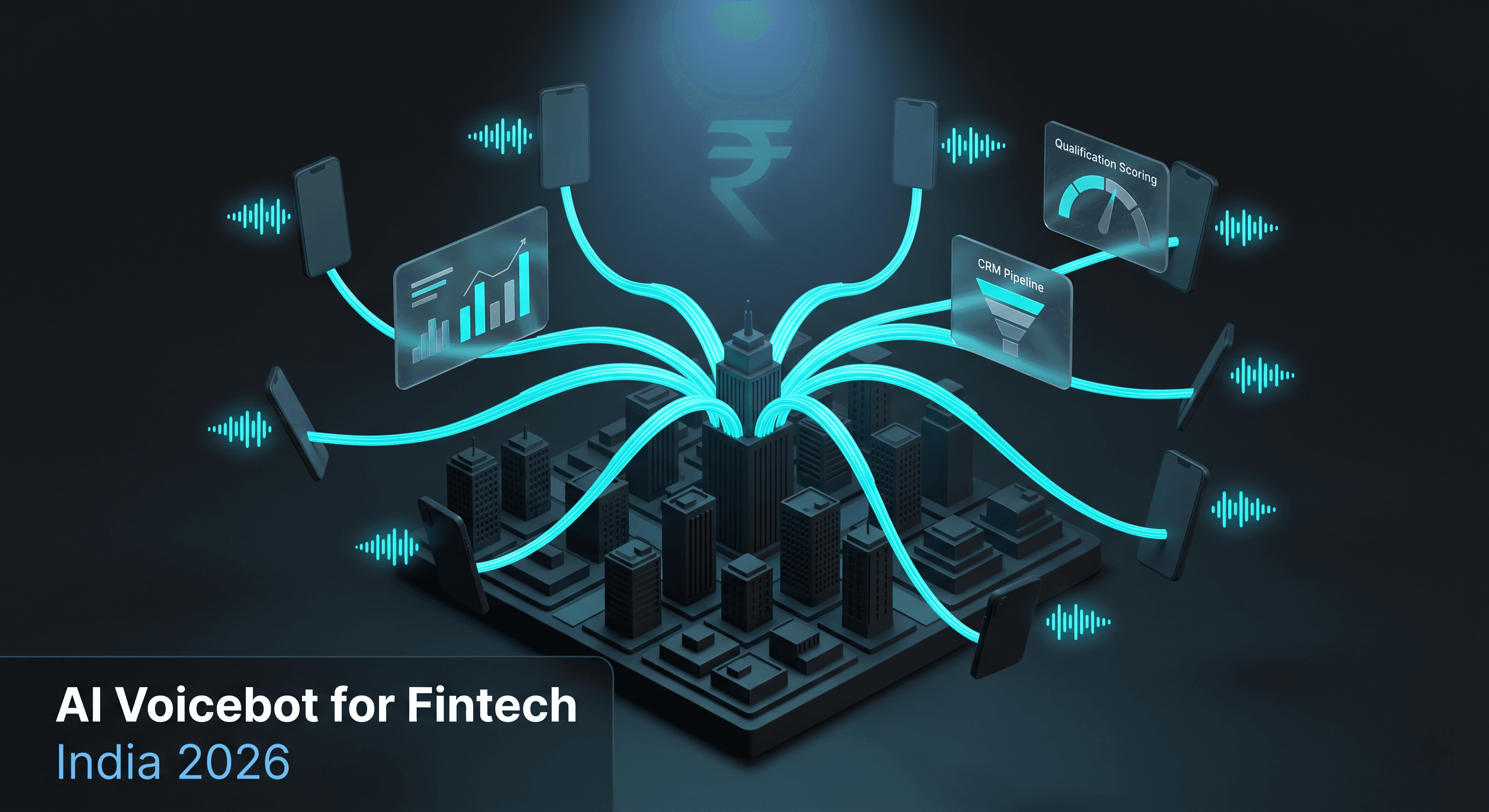
How Indian Fintech Companies Are Using AI Voicebots to Qualify Leads in Under 60 Seconds
Indian fintech teams lose conversions in the gap between form submit and first callback. AI voicebots close that gap with instant qualification and CRM updates.
Key takeaway: In Indian fintech, the single biggest leak in the sales funnel is the gap between a lead submitting their information and someone calling them back. AI voice agents close that gap to under 60 seconds, qualify the lead completely, and update the CRM before the human sales team even sees the notification.
- What 60-second callback automation looks like
- The qualification conversation
- Compliance considerations for AI voice in BFSI India
- What happens after the call
- Results fintech teams are seeing
- How to get started
- Frequently asked questions
The lead response problem in Indian fintech
Every fintech company running performance marketing in India knows this number: the first five minutes after a lead submits their information is when conversion probability is highest. After 30 minutes, conversion probability drops by more than half. After an hour, you are chasing a cold lead.
But here is the reality on the ground. Most fintech sales teams, even well-resourced ones, have a lead response time of 15 to 45 minutes during business hours, and zero response outside business hours. If a prospect fills out a loan enquiry form at 8 PM, the first callback might happen at 10 AM the next morning.
In that gap, competitors call. The prospect finds another option. Or they simply move on.
AI voice agents solve this problem entirely. At QuensultingAI, we deploy voice stacks built on Retell, Vapi, Dograh, or Plivo depending on latency, language, and telephony requirements, orchestrated through n8n and connected to your CRM and WhatsApp follow-up.
What 60-second callback automation looks like
The trigger sequence for a fintech AI voicebot looks like this:
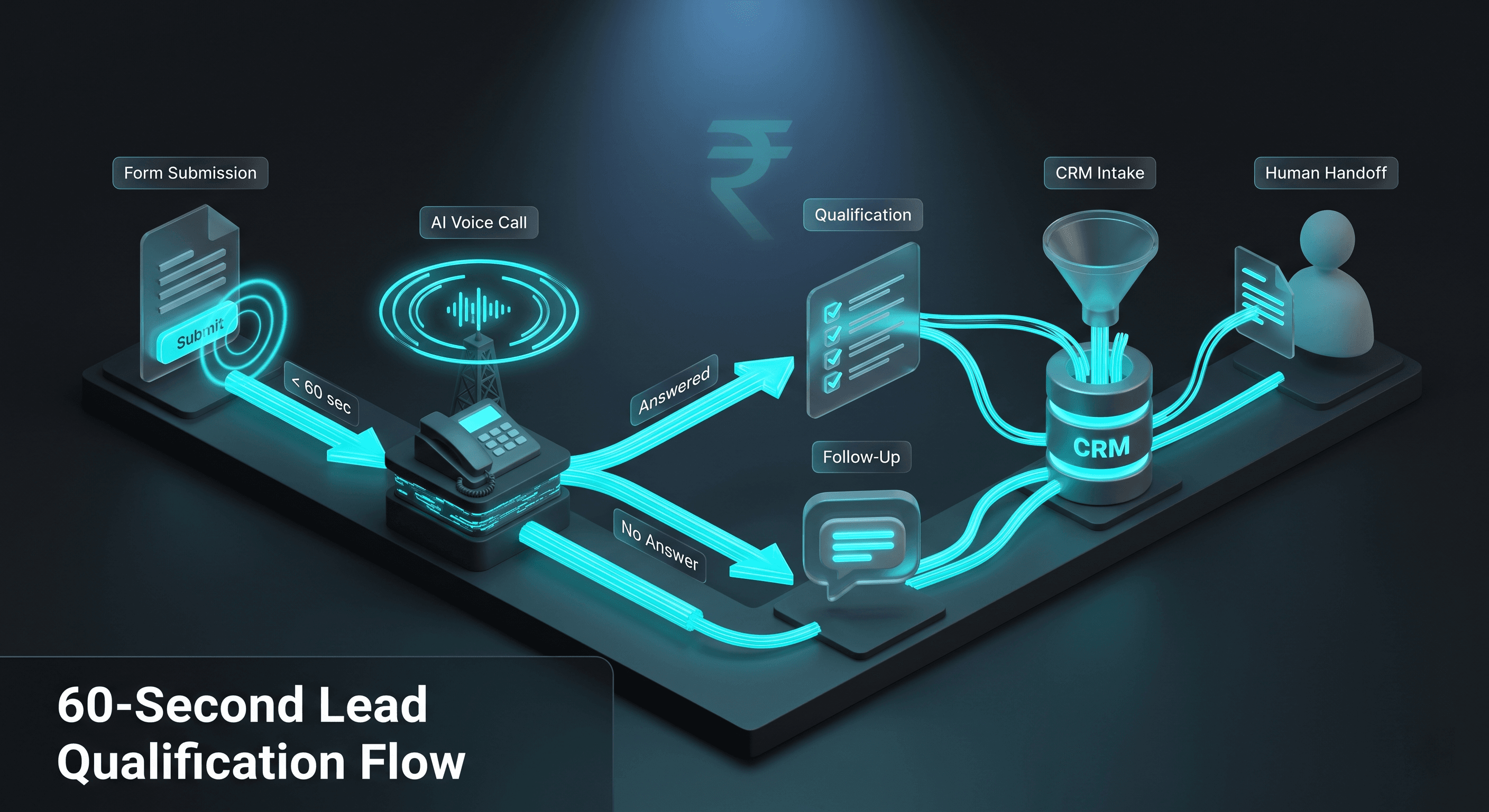
The system connects your lead capture form, CRM, and voice agent in a single n8n automation workflow. When a lead submits, the webhook fires, the CRM record is created, and the outbound call is placed within the same minute. No human in the loop at this stage. The AI handles the qualification entirely.
For leads who do not pick up, the system sends a simultaneous WhatsApp message: a personalised note referencing the product they enquired about, with a callback link. If the lead does not respond to either the call or the WhatsApp within two hours, a follow-up sequence begins automatically. That usually means a second call attempt, then a second WhatsApp at a different time of day.
This pattern works for personal loans, credit cards, mutual fund SIP enquiries, and insurance products. The trigger is the same. The qualification script changes by product.
The qualification conversation
The AI voice agent does not just ask if the lead is interested. It runs a structured qualification conversation designed around your specific product.
For a personal loan product:
- Monthly income confirmation
- Employment type (salaried or self-employed)
- Existing loan obligations
- Loan amount and tenure preference
- CIBIL awareness (does the prospect know their score?)
- Timeline: immediate need or future planning
For insurance:
- Coverage need (life, health, vehicle)
- Existing policies
- Budget range
- Nominee details as an intent signal
- Decision timeline
All of this happens in a natural conversation, not a rigid script. The AI listens to what the prospect says and adapts. If a prospect says they are looking for around 10 lakhs, the AI confirms, explores tenure preference, and moves naturally to the next qualification point.
Hindi-English code-switching is handled well by modern voice platforms. Regional language support is available through model and provider selection.
Compliance considerations for AI voice in BFSI India
This section is non-negotiable. AI calling in the BFSI sector in India operates within RBI guidelines for digital lending and TRAI's unsolicited commercial communication (UCC) regulations.
Key requirements your AI voice implementation must meet:
- Consent at point of lead capture. The form submission must include explicit consent language for callback.
- DNCR scrubbing. Outbound calls must be checked against the Do Not Call Registry before dialling.
- Disclosure requirement. The AI voice agent must clearly identify itself as an automated system at the start of the call.
- Call recording consent. Inform the caller that the call is being recorded for quality purposes.
- Data storage. Call recordings and transcripts must be stored in compliance with DPDPA 2023 data localisation requirements.
At QuensultingAI, every BFSI voice AI deployment includes a compliance review as part of the implementation process. We do not deploy systems that skip these requirements.
What happens after the call
The conversation ends. This is where many voice AI deployments drop the ball, and where the real value is.
A properly integrated fintech voicebot does all of this automatically within seconds of the call ending:
- Extracts structured data from the conversation (income confirmed, loan amount stated, employment type, sentiment)
- Maps that data to the correct fields in your CRM (HubSpot, Salesforce, Zoho, LeadSquared)
- Moves the lead to the correct pipeline stage: Qualified, Follow-Up Required, Not Interested, or Callback Requested
- Tags the lead for the right human sales agent based on product, ticket size, or geography
- Triggers a WhatsApp follow-up if the prospect requested specific information
- If the lead asked to speak to a human, creates a priority task in the CRM with call summary attached
The human sales team's first interaction with the lead is not a cold call. It is a warm call with a full qualification briefing in the CRM: income, loan amount, timeline, sentiment, and any specific questions the AI noted.
Results fintech teams are seeing
Across fintech deployments, the consistent improvements are:
- Lead response time: From 15 to 45 minutes to under 60 seconds
- Contact rate: From 40 to 60 percent to 75 to 85 percent (more leads reached before they go cold)
- Qualification speed: Full qualification data available in CRM in under three minutes vs. two to three days for manual follow-up teams
- After-hours coverage: 100 percent of leads receive first contact within 60 seconds regardless of time of day
These numbers matter because they directly affect the return on your performance marketing spend.
How to get started
The minimum viable fintech lead qualification system requires four components:
- A voice agent configured with your qualification script (Retell, Vapi, or Dograh depending on your requirements)
- A telephony connection (Plivo, Twilio, or Exotel) for Indian number calling
- An n8n workflow connecting your lead source to the calling trigger
- A CRM integration for post-call data mapping
Implementation time at QuensultingAI: three to four weeks from brief to first live call.
Talk to our team to scope your specific use case.
Frequently Asked Questions
Yes, with the correct consent, DNCR compliance, and AI disclosure at call start. Our implementations include a full compliance review.
Yes. Modern voice platforms handle Hindi-English code-switching naturally. Regional language support (Tamil, Kannada, and others) is available via model selection.
HubSpot, Salesforce, Zoho CRM, LeadSquared, GoHighLevel. Custom webhook connections for proprietary CRMs.
An IVR routes calls based on key presses and recognises limited phrases. Generative AI voice agents have a full natural language conversation. They understand context, handle objections, and adapt to what the caller says. Call quality is significantly better, and containment rates are 30 to 40 percent higher.
Ready to Get Started?
Let's discuss how voice AI can transform your business. Free consultation available.