
Rajesh K Babbar
Content & Insights
AI Automation for Indian D2C Brands - Cart Recovery, Customer Support, and Post-Purchase Flows
Indian D2C brands fight for margin on every order. AI automation recovers abandoned revenue, cuts support cost, and drives repeat purchases automatically.
Key takeaway: Indian D2C brands are fighting for margin on every order. AI automation in e-commerce is not about technology for its own sake. It is about recovering abandoned revenue, reducing customer support cost, and increasing repeat purchase rates, automatically.
- The four automation opportunities for Indian D2C
- The tech stack
- Implementation timeline and cost
- Frequently asked questions
The D2C automation opportunity in India
India's D2C e-commerce market is growing faster than almost any other in the world. But the economics are brutal: rising CAC, thin margins, and a customer base that expects instant responses on WhatsApp.
Most D2C brands are still handling customer support manually. The same agent answering "where is my order" 200 times per day. The same person sending cart reminder messages from their phone. The same team member chasing down returns manually.
AI automation changes the unit economics of D2C operations. QuensultingAI connects Shopify or WooCommerce webhooks to n8n, WhatsApp Business API, and voice callbacks via Retell, Vapi, or Plivo depending on cart value and use case.
The four automation opportunities for Indian D2C
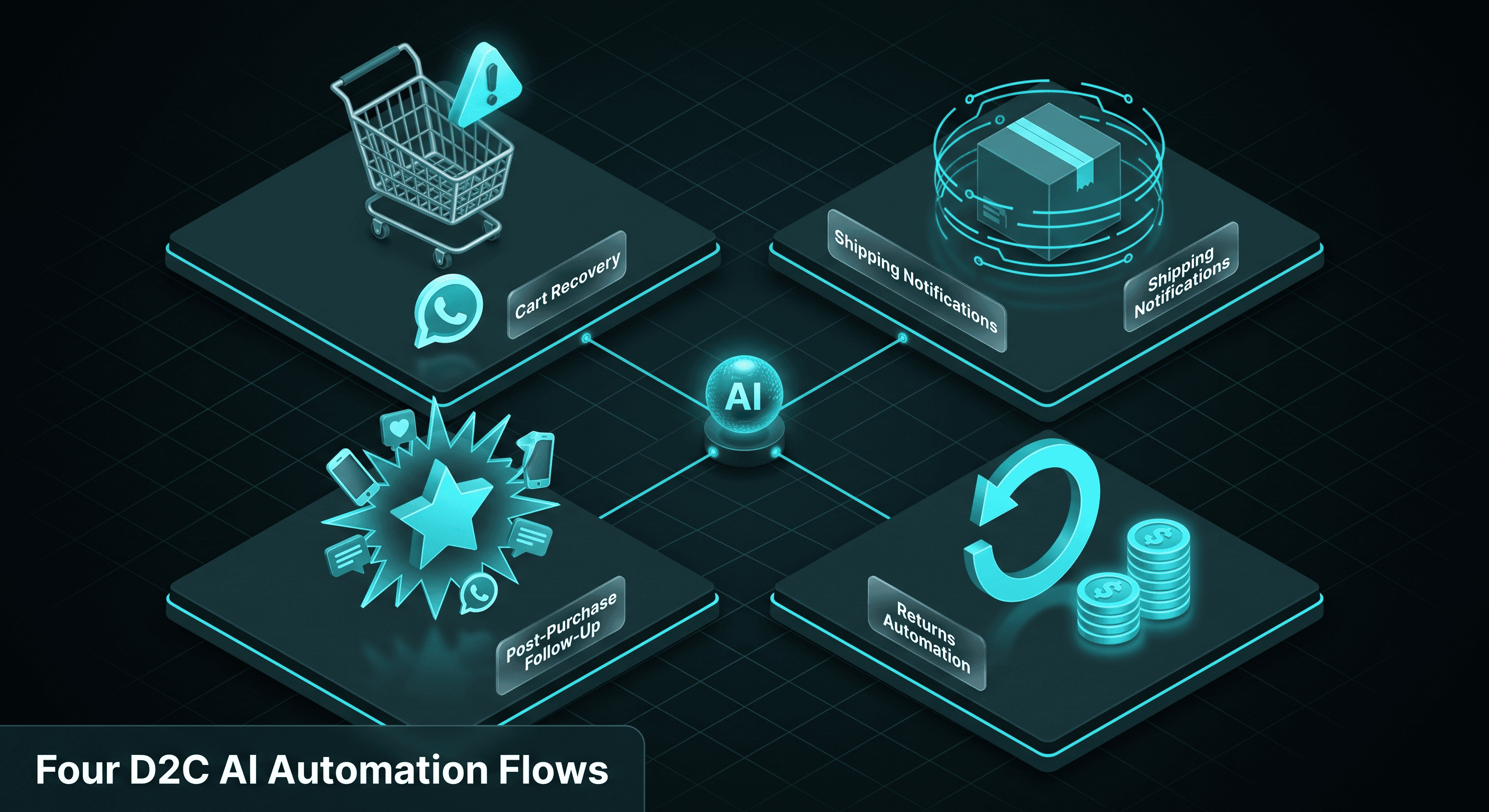
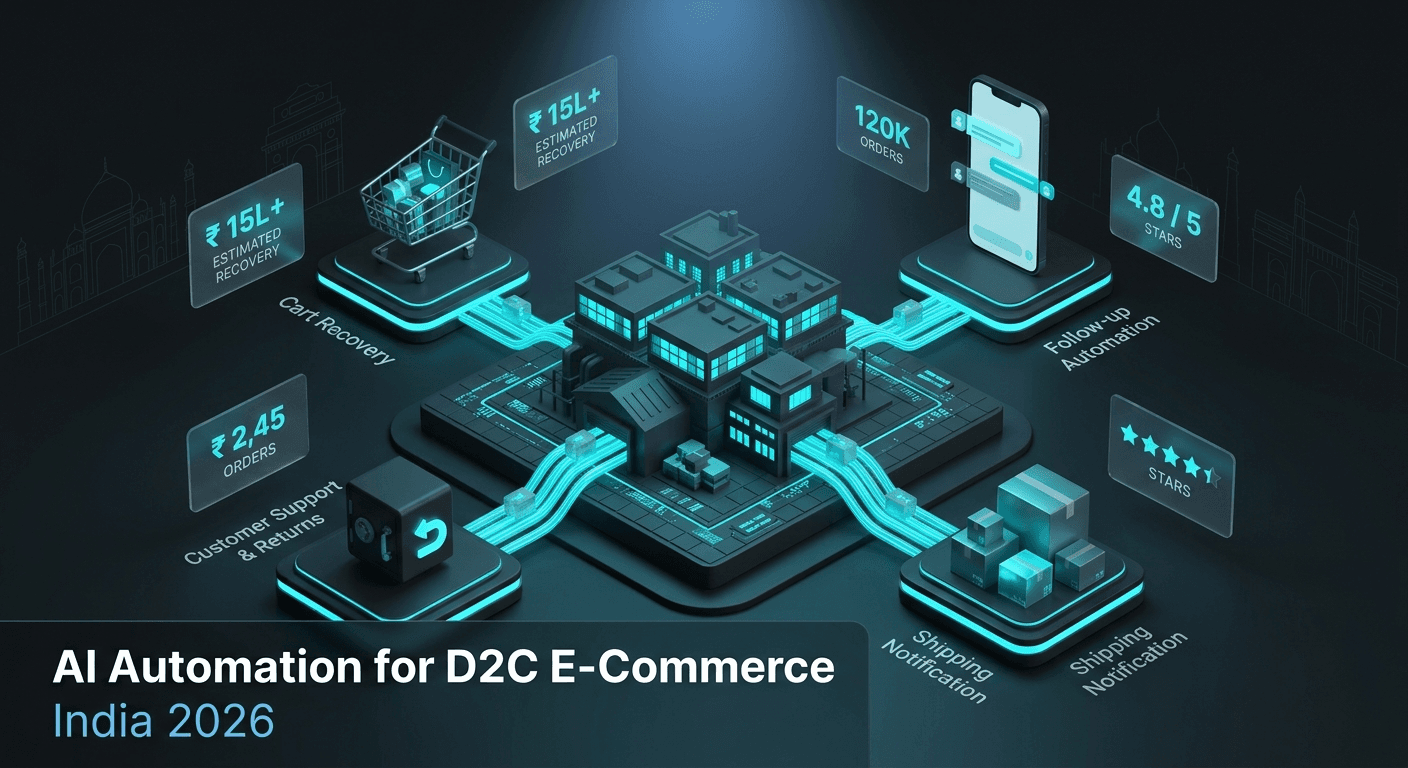
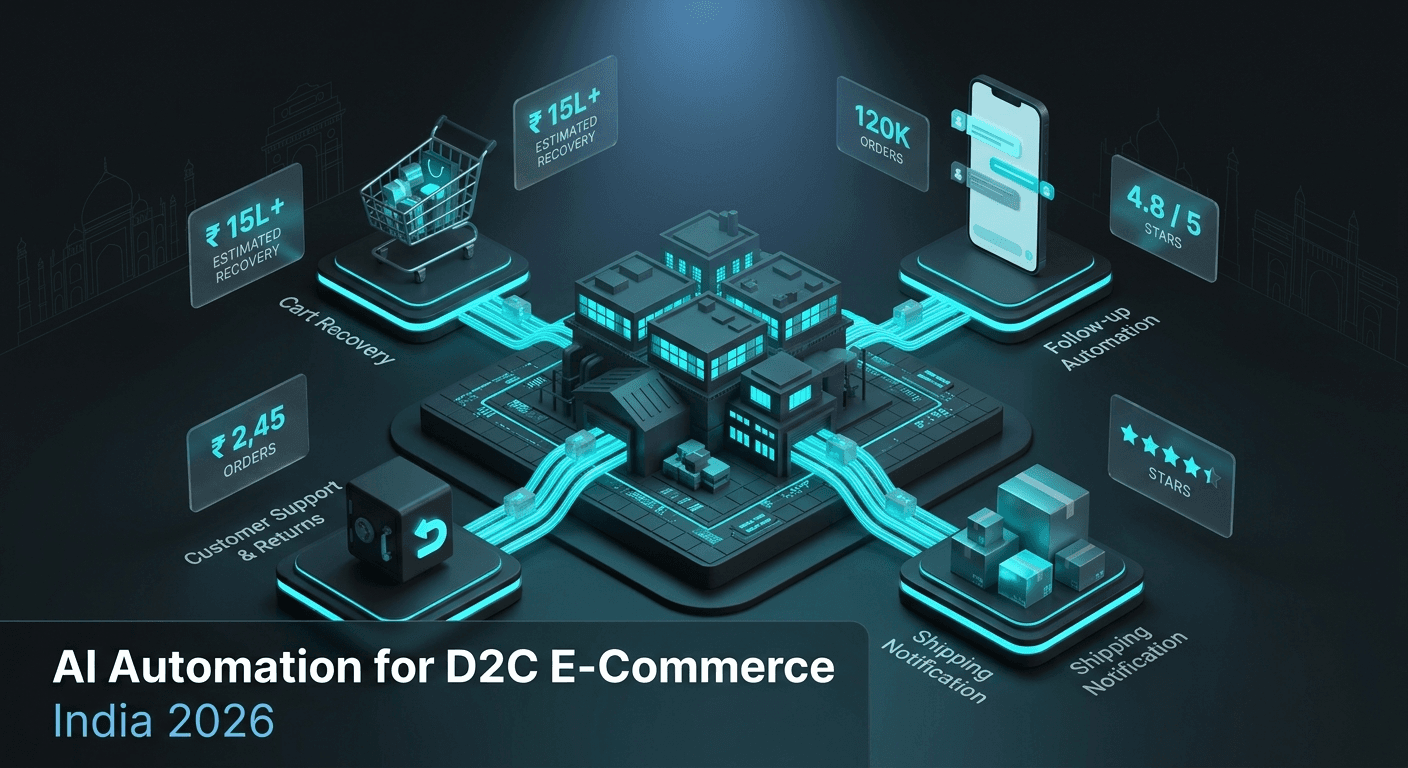
1. Abandoned cart recovery (WhatsApp + Voice)
India's cart abandonment rate of 70 to 80 percent means the majority of shopping intent on your site never converts. Most brands try to recover these with generic email sequences that Indian shoppers largely ignore.
WhatsApp cart recovery with AI personalisation is dramatically more effective. When a cart is abandoned, the system:
- Sends a WhatsApp message within 15 to 30 minutes, personalised with the specific product name and a photo if the cart contains a single item
- If no response in 24 hours, a second message with a time-limited offer
- If cart value is above a threshold (for example Rs. 3,000+), a voice callback is triggered via Retell or Vapi. A personalised call that references the specific product and asks if the shopper had questions
Recovery rates: 15 to 35 percent of abandoned carts that receive WhatsApp outreach vs. 3 to 5 percent from email.
2. Order and shipping notifications
Order confirmation, shipment dispatched, out for delivery, delivered. All triggered automatically via WhatsApp. The AI handles "where is my order" queries by looking up the order status in real-time and responding instantly.
Benefit: Eliminates the highest-volume customer support query from your manual team.
3. Post-purchase sequence and review request
Within three to five days of delivery, an AI-powered WhatsApp message:
- Checks in on the delivery experience
- Offers help if there are any issues
- Requests a Google or platform review with a direct link if the customer responds positively
- Captures product feedback
This drives review volume without requiring any manual team effort.
4. Returns and refunds automation
The most time-consuming customer support scenario for D2C brands. An AI chatbot that handles:
- Return initiation via WhatsApp (captures reason, product, order number)
- Triggers the return pickup with your logistics partner
- Provides refund timeline automatically
- Escalates to human support for exceptions (damaged products, fraud flags)
The tech stack
| Component | Tool |
|---|---|
| WhatsApp Business API | Meta Business API |
| Automation orchestration | n8n |
| E-commerce integration | Shopify webhook or WooCommerce API |
| Voice callbacks | Retell, Vapi, or Plivo via Twilio/Exotel |
| CRM | HubSpot, Zoho, or Shopify customer data |
Every conversation and order event syncs to your CRM. Support agents see order history, return status, and prior WhatsApp threads before they pick up an escalated case.
Implementation timeline and cost
A typical D2C automation rollout at QuensultingAI:
- Week 1 to 2: Shopify/WooCommerce webhook setup, WhatsApp Business API connection, cart recovery flow
- Week 2 to 3: Order notification and WISMO (where is my order) automation
- Week 3 to 4: Returns flow and post-purchase review sequence
- Optional: High-value cart voice callback integration
Implementation cost: Rs. 60,000 to Rs. 1.5L depending on number of flows and integrations. Monthly running cost for a brand doing 1,000 orders per month: approximately Rs. 8,000 to Rs. 20,000 including WhatsApp conversation fees and automation hosting.
Frequently Asked Questions
Yes. Shopify webhooks trigger all key events (cart abandoned, order confirmed, shipment dispatched, delivered) directly into the n8n automation.
Yes. The automation identifies payment method and routes COD returns through a different flow (bank account collection for refund vs. source reversal for prepaid).
Any platform with webhook or API access can trigger the same n8n workflows. WooCommerce, Magento, and custom builds are supported.
Voice callbacks are most effective for high-AOV carts (typically Rs. 3,000+) where a personal touch can recover a sale that WhatsApp alone did not convert. For lower ticket items, WhatsApp sequences alone usually deliver the best ROI.
Yes, when implemented through Meta Business API with approved message templates for outbound notifications. QuensultingAI configures templates during implementation.
Ready to Get Started?
Let's discuss how voice AI can transform your business. Free consultation available.