
Rajesh K Babbar
Content & Insights
AI Call Center Automation for Indian SMEs : Inbound, Outbound, and Hybrid Models in 2026
Indian SMEs cannot staff 50-seat call centers. AI automation delivers enterprise-level inbound handling, outbound campaigns, and human escalation at a fraction of the cost. Full 2026 implementation guide.
Key takeaway: Indian SMEs do not need a 50-seat BPO floor to run professional call operations. AI handles high-volume inbound FAQs, outbound renewals, and lead qualification. Humans stay in the loop for complex, emotional, or high-value cases. That hybrid model is what works in production.
- Inbound automation for SMEs
- Outbound automation for SMEs
- The hybrid model that actually scales
- Cost per contact: human vs AI
- Tech stack and platform choices
- 90-day implementation timeline
- Frequently asked questions
What AI call centers handle vs human agents
Traditional call centers scale headcount linearly with call volume. Every new product line, seasonal spike, or marketing campaign means hiring, training, and managing more agents.
AI call center automation inverts part of that equation. Voice AI handles repeatable, high-volume intents at marginal cost near zero per additional minute. Humans focus on exceptions: negotiation, complaints, regulatory-sensitive conversations, and high-ticket sales closes.
Strong AI fits:
- Order status and delivery ETA queries
- Appointment booking and rescheduling
- Policy renewal reminders and payment links
- Lead qualification after form submission
- Tier-1 support FAQs with knowledge base answers
- After-hours coverage when human teams are offline
Keep humans in the loop for:
- Collections negotiation beyond standard scripts
- Medical or legal advice boundaries
- Angry customers requiring empathy and policy exceptions
- Complex B2B deals with multi-stakeholder dynamics
The goal is not full replacement. It is intelligent routing plus automation of the 60 to 80 percent of contacts that follow predictable patterns.
Explore call center automation solutions built for this split.
Inbound automation for SMEs
Inbound is where many Indian SMEs feel pain first. Marketing drives traffic. Phone lines ring. Two or three people cannot keep up. Callers hit voicemail or long hold times. Leads leak.
AI inbound agents replace legacy IVR with natural conversation:
- Answer and identify intent in Hindi, English, or code-switched Hinglish
- Authenticate with simple verification where needed (order ID, registered mobile last four digits)
- Resolve or collect information from CRM, OMS, or ticketing API
- Create ticket if resolution requires human follow-up
- Transfer warm to human agent with full transcript summary
For customer support use cases, containment rate and customer satisfaction depend on knowledge base quality and escalation speed, not on whether the first voice was synthetic.
Indian telephony integration typically runs through Exotel or Plivo for local DIDs, connected to Retell AI, Vapi, or Dograh on the conversation layer.
Outbound automation for SMEs
Outbound AI unlocks campaigns that were previously too expensive to run consistently:
- Renewals: insurance, SaaS subscriptions, AMC contracts
- Collections: EMI reminders with WhatsApp payment links
- Lead qualification: callback within 60 seconds of form fill
- Appointment confirmations: healthcare, real estate site visits
- Event and webinar reminders: registration-to-attendance lift
Each campaign needs consent, DNCR scrubbing where applicable, AI disclosure, and calling window compliance. Outbound without governance fails in production regardless of model quality.
Our voice AI bots deployments treat outbound as a governed program, not a dialer bolt-on.
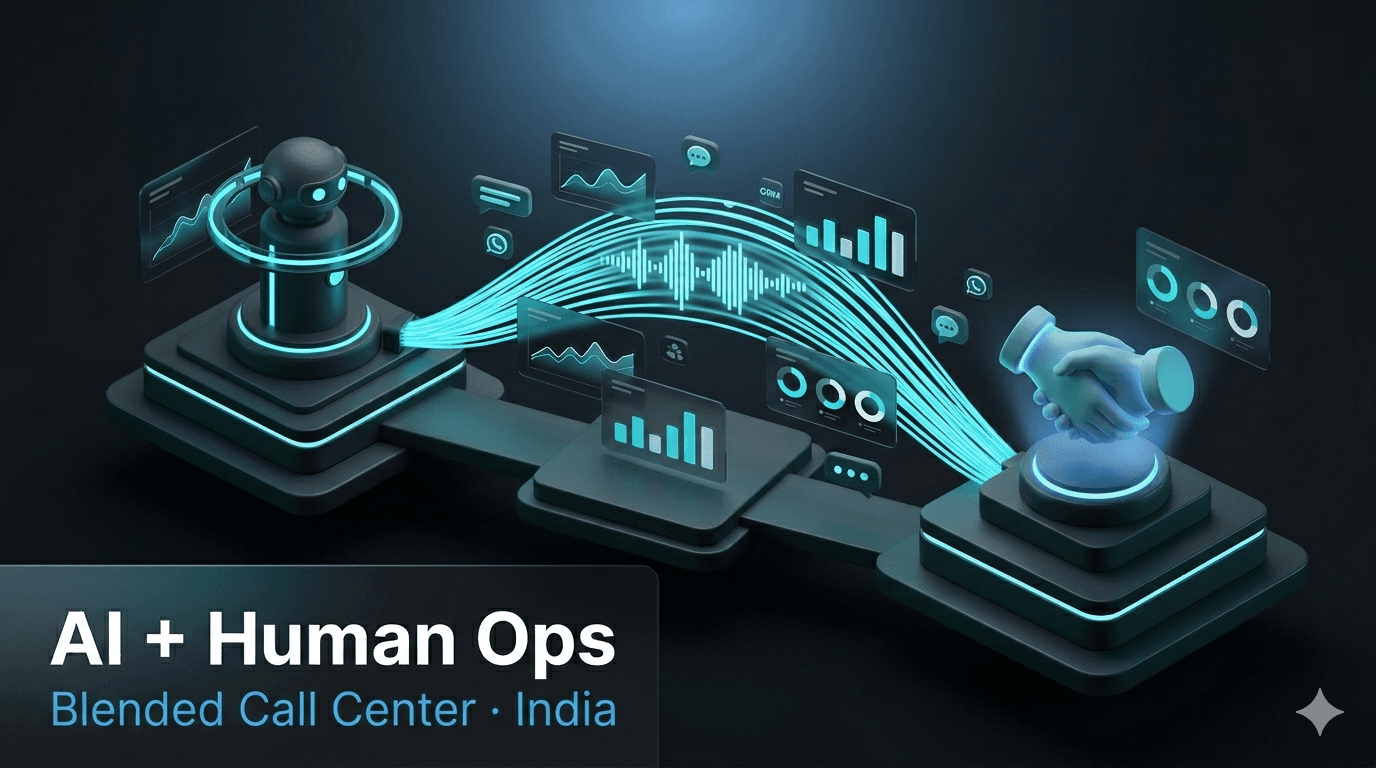
The hybrid model that actually scales
Pure AI-only call centers fail when escalation is an afterthought. Pure human centers fail on cost at scale. The hybrid model defines clear rules:
| Layer | Role |
|---|---|
| AI first line | Handle defined intents, collect structured data |
| Queue logic | Route by intent, sentiment, customer tier, language |
| Human pool | Receive warm transfers with transcript and CRM context |
| Supervisor | Review failure clusters weekly, update knowledge base |
Warm transfer means the human sees why the caller is on the line before saying hello. Cold transfer to a general queue destroys the automation ROI.
WhatsApp extends the hybrid model. If outbound call is unanswered, WhatsApp follow-up captures response asynchronously. If inbound AI resolves partially, WhatsApp sends confirmation and tracking link.
Cost per contact: human vs AI
Exact numbers vary by city, shift, and BPO tier, but directional economics are consistent for Indian SMEs:
Human outbound agent (fully loaded): roughly ₹25 to ₹45 per productive contact minute when you include salary, seat cost, dialer, supervision, and attrition retraining.
AI voice minute (platform + telephony + LLM): typically ₹3 to ₹12 per minute all-in at SME volumes, depending on platform (Retell, Vapi, Dograh), model choice, and carrier.
Break-even logic: If AI handles 70 percent of contacts without human involvement, effective cost per resolved contact drops sharply even when you maintain a smaller human team for escalations.
AI is not free. Implementation, integration, and ongoing prompt and workflow maintenance have cost. But the marginal cost per additional call is what makes seasonal campaigns and after-hours coverage economically viable for SMEs.
Tech stack and platform choices
A production SME call center stack in India usually includes:
- Voice AI: Retell AI, Vapi, or Dograh (we deploy all three based on use case)
- Telephony: Exotel, Plivo, or Twilio India
- Automation: n8n for CRM, ticketing, WhatsApp triggers
- CRM / helpdesk: Zoho, HubSpot, Freshdesk, or Zendesk
- WhatsApp: Meta Business API for async follow-up
QuensultingAI is platform-agnostic. Retell certification reflects depth on one strong platform, not exclusivity. Many clients run Vapi for developer-heavy custom flows or Dograh where enterprise routing patterns fit better.
90-day implementation timeline
Days 1 to 30: Inbound or outbound pilot
- Pick one high-volume intent (e.g., order status or renewal reminder)
- Configure voice agent, telephony, CRM write-back
- Launch with capped daily volume and human overflow
Days 31 to 60: Expand intents and tune escalation
- Add second intent cluster based on transcript review
- Fix top 5 failure reasons from week-one data
- Align supervisor review cadence
Days 61 to 90: Hybrid optimisation
- Balance AI containment vs customer satisfaction
- Add WhatsApp async path for no-answer outbound
- Document runbooks for ops team
Most SME deployments go live with a pilot intent in 3 to 4 weeks. Full hybrid program maturity typically lands inside one quarter.
Frequently Asked Questions
Yes. SMEs often benefit most because they cannot afford 24/7 human coverage but lose leads without it.
Disclosure plus fast resolution beats hidden IVR frustration. Quality of conversation matters more than synthetic vs human first touch.
Start with whichever channel has measurable volume and clear intent boundaries. Renewal outbound and support inbound are common first picks.
Usually no. Voice AI platforms integrate with existing Indian carriers via SIP or API.
Related on this site
Ready to Get Started?
Let's discuss how voice AI can transform your business. Free consultation available.